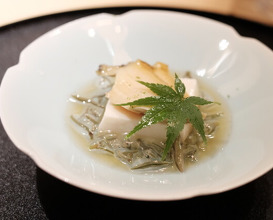
Osaka, NishitenmaToday is Shoman, the time when silkworms begin to eat mulberry leaves. As the saying goes, "U no Hana Kusushi," it’s a humid, rainy day in Osaka.I headed north from Yodoyabashi to Nishitenma. The streets are surprisingly beautiful. There are so many foreigners here, it hardly feels like Japan.It’s been a while since I visited "Zeshin." I took a seat at the counter. It’s been about ten years since my first visit, and since I mentioned that my daughter’s name includes "Kaze" (wind), every time I come, I receive a coaster with the character "風" on it. My daughter is off to Okinawa for a school trip starting today.Now, for the first dish. Sesame tofu with abalone and jun-sai (water shield). The jun-sai from Akita is small but has a lot of jelly-like texture, making it delightful to eat. And the flavor of the sesame tofu is exquisite. It seems to have been blended so well that its texture is incredibly fine, surpassing the word "rich"—it’s something entirely different.Next, we have zunda (edamame) beans, Amela tomatoes, octopus, and vinegared hairy crab. Each has a different seasoning, some sweet, some sour, and each with its own texture, creating a wonderful dish. "Yes, my stomach is ready!"The soup features scallop shinjyo (a type of dumpling) and bamboo shoots. This dish has a unique sweetness flowing from the broth. "The flavor of the bamboo shoots really stands out."The sashimi includes toro-taku (fatty tuna with pickled radish) and striped jack, aged squid, and akou (red sea bream). "They’re attacking with different sweetnesses." The wasabi is exceptionally delicious today.Having passed Rikka and welcomed Shoman, my body feels a bit sluggish from the fatigue since the start of the year. So, they’ve infused layers of "sweetness" to nourish the body.For the hassun (seasonal platter). On a tray resembling yatsuhashi (a type of sweet), there are meat, fish, vegetables, dairy, and seafood. Decorated with irises, there are eight items in total. "They’re really particular about this!" The tempura of young sweetfish is incredibly delicious. "I can understand why sweetfish is called a fragrant fish."Next is a dish with round eggplant and sakura shrimp. "This sweetness is absolutely impossible to recreate at home!" It’s fascinating how the eggplant, when combined with the broth, gives off a tea-like aroma. The fried sakura shrimp, combined with that aroma, creates an extremely fragrant dish. "This is rare and difficult to achieve." I could never make something like this.The rice is anago (conger eel) rice. "So this is what you’re serving!" "I’ve never mentioned that I lived in Hiroshima!" I recognize the conger eel soy sauce rice as being based on "Ueno" in Miyajima. "This is an extremely, extremely delicate sweetness!" For some reason, today’s dishes are all showcasing the very best "sweetness".Finally, I had a sweet called "Kunpu" (fragrant breeze). It shares the same meaning as my daughter’s name. The sweet red bean paste mixed with yomogi (mugwort) adds a nice accent to the fragrant breeze.Ah, what a delight. "Delicious + Fun = I Love It!"The phrase that popped into my head while eating was quite difficult to express, but to serve such exquisite dishes is truly "something else." It deserves the highest praise.And the chef, Sekine-san’s, carefree smile is the best. I feel "healed" by the flavors and Sekine’s touch.I was so moved that I felt like I could lose my mind.Well then.*I’ve used this place many times, and it’s a restaurant for all ages. Even during lunch, they put effort into the hassun, showcasing the essence of kaiseki cuisine. From the beginning to the farewell, the chef’s greetings and conversations never cease. Thank you always! Also, I fell in love with the sake pairing.
We use cookies on this site to enhance your user experience.