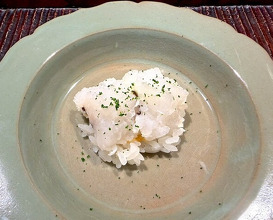
Nestled in a back alley of Kagurazaka, the renowned Japanese restaurant "Kagurazaka Ishikawa" is led by Chef Hideki Ishikawa. After establishing his own business in 2003, he opened this restaurant in 2008. True to the words displayed on the official website, "Clear flavors, clear air, clear heart," both the cuisine and the ambiance quietly align with your senses.This Michelin three-star establishment carries a certain tension typical of high-end Japanese cuisine, yet once you taste the dishes, you realize they showcase a subtle beauty through the handling of ingredients, dashi, cooking techniques, and seasoning, rather than ostentatious flair.The meal began with gently grilled Amakusa conger eel served with rice and sea cucumber roe. The eel was fragrant and tender, harmonizing beautifully with the mild sweetness of the rice and the deep umami of the sea cucumber roe. Instead of overwhelming you from the start, it smoothly guides your palate into the flow of the meal. It’s quiet yet leaves a lasting impression.Next came the young sweetfish from the Tenryu River. The fish's flavor gradually unfolds, with a delightful balance of bitterness and aroma complemented by the umami of the accompanying ingredients. It skillfully retains the freshness typical of young sweetfish without being overly light.The soup featured the famous clams from Kuwana. The dashi was gentle, yet as you sip, a robust umami gradually emerges. The clams spread their flavor on the tongue, while the melon provides a refreshing contrast. This bowl was mild yet left a strong aftertaste.The sashimi included Meita flounder, purple sea urchin, and red sea urchin. The Meita flounder offered a rich, deep flavor that became more pronounced with each bite. The purple sea urchin had a clear sweetness and pure umami, while the red sea urchin was creamier and more expansive in flavor. It was a delightful dish that clearly showcased the differences in sea urchin.The grilled fish was cooked to a perfect medium-rare. This was particularly impressive, as it retained a moist texture close to raw, while the cooking brought forth its aroma and umami. The seasoning was spot on, beautifully highlighting the sweetness of the fat and the umami of the flesh. A simple yet refined dish.The Kamo eggplant from Kyoto was prepared as if steamed with salt. It was juicy and sweet, with a melting texture. A gentle hint of ginger added a nice accent, keeping it from being too heavy while beautifully balancing the juiciness. This is a prime example of how Japanese cuisine can elevate the natural sweetness and moisture of eggplant.The combination of Tanba black chicken, caviar, and winter melon was also memorable. The chicken had a deep umami that intensified with each bite. The saltiness and flavor of the caviar paired well with the dashi infused in the winter melon. Instead of clashing, the strength of the chicken and the caviar created a harmonious contrast.The simmered dish featured junsai (water shield), hon-ara (a type of fish), and Kuze eggplant. The hon-ara delivered a gentle umami, while the Kuze eggplant had a firm texture that absorbed the dashi beautifully, making it a personal favorite. The smooth texture of the junsai added a refreshing touch.The sesame somen noodles served as a palate cleanser. They were creamy yet refreshing, with a lingering sesame flavor that was light and not heavy. This transition within the course was very pleasant.Then came the rice. It consisted of Niigata Koshihikari rice, steamed with bonito, chirimenjako (tiny dried sardines), and small squid, accompanied by shirasu oroshi (grated daikon with baby sardines), salted kelp, clam miso soup, and pickles. The small squid had a delightful bitterness that paired perfectly with the white rice. The clam miso soup was comforting and soothing. The rice at Ishikawa has a power that makes you think, "This is how Japanese cuisine should conclude."For dessert, we had melon and watermelon. The watermelon was likely the golden variety from Kumamoto, bursting with sweetness, especially the watermelon, which had a rich sweetness reminiscent of grapes. Finally, we enjoyed black sesame agar jelly with coconut milk. The jelly had a subtle sweetness, beautifully complemented by the creaminess of the coconut milk.Overall, the cuisine at Ishikawa features gentle dashi, delicate seasoning, precise cooking of ingredients, and a seamless transition between cool and warm elements. This accumulation of flavors takes you to a profound place without you even realizing it.Rather than the tension one might expect from a Michelin three-star title, the experience is more natural and deeply fulfilling. It’s a strength that resonates more than mere flamboyance. After finishing the meal, the memories of the dashi, rice, and soup linger on. That, I believe, is the true charm of Ishikawa.
We use cookies on this site to enhance your user experience.