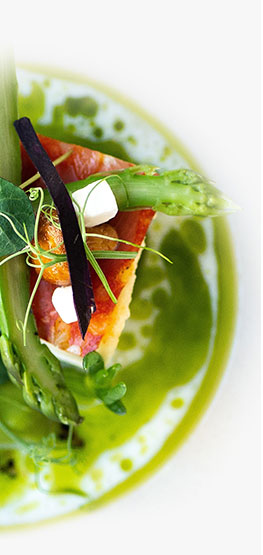
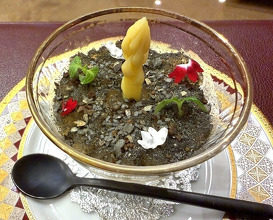
I visited the reservation-only restaurant "Tout La Joie Ism" in Nagoya, known for its difficulty in securing a table. Located in the Naka Ward of Nagoya, this innovative restaurant has been recognized as a special establishment representing the city since its predecessor, "Tout La Joie."The course I experienced that day was built on French cuisine, seamlessly incorporating elements like Japanese dashi, kombu, sweetfish, lobster, spices, and fermentation. Despite the free-spirited creativity, each dish surprisingly came together harmoniously. Each plate made me think, "I didn’t expect that!" while ultimately delivering a satisfying taste.We began with a dish featuring white asparagus, low-temperature oven-cooked beef, and a jelly made from homemade bacon extract. The creamy texture allowed the savory flavor of the bacon to spread gently. The gentle sweetness of the white asparagus combined beautifully with the richness of the beef and bacon, while the crispy texture of the bread-like crust added a delightful accent. From the very first dish, the layering of flavors was impressively intricate.Next was a spring roll filled with young sweetfish. This dish combined jelly, balsamic vinegar, white balsamic vinegar, strawberries, and Japanese knotweed leaves. The slight bitterness of the sweetfish paired well with the acidity of the balsamic and the sweetness of the strawberries. The aroma of the knotweed leaves enhanced the bitterness beautifully, making it an interesting dish that showcased the sweetfish while balancing sweet and sour notes with fragrance.The following dish seemed to be themed around Kagoshima. It featured Thai fish paste, young yomogi (mugwort), blue lobster meat, sautéed in butter, homemade yuba (tofu skin), sea urchin from Nemuro, and a lobster dashi soup. The soup was rich but not overly heavy, allowing the umami of the lobster to shine through. The Thai fish paste had a sticky texture that paired well with the aroma of the yomogi. The sweetness of the sea urchin and the soft texture of the homemade yuba added depth, creating a dish that felt distinctly Japanese without being too heavy, making it one of my favorites.The sautéed spring cabbage was also impressive. It included spring cabbage, bamboo shoots, star red cabbage, Hida beef rillettes, and garam masala. The sweetness of the cabbage naturally blended with the spice aromas. The deep umami of the Hida beef melted into the sauce, providing a satisfying experience despite being a vegetable dish. The balance of the cabbage's sweetness, the aroma of the garam masala, and the richness of the beef created a delightful harmony of spring flavors and meaty goodness.The Ezo abalone gratin was crafted with rikyufu (a type of wheat gluten), beef, and katsuobushi dashi, covered with a thin layer of oblaat. The rich flavor of the abalone combined with the mellow katsuobushi dashi. The addition of beef umami made it rich yet gentle. The texture of the abalone, the softness of the gluten, and the umami of the dashi came together, giving the impression of a dish layered with Japanese flavors rather than a typical Western-style gratin. The beef was also tender and delicious.The black-haired wagyu strip loin was prepared by removing the outer layer of the strip loin and marinating it with batta kombu. Additionally, pork was cooked down and used as a sauce with the thickening properties of ma-kombu. The beef was incredibly tender, with a rich sweetness from the fat and a deep umami flavor. The kombu's umami intertwined beautifully, enhancing the overall taste. Instead of simply serving good meat, the use of kombu to refine and layer the flavors was fascinating. This dish was simply too delicious.The classic "M Salad" featured organic vegetables. A sauce reminiscent of concentrated dried fruits was used, and the vegetables were astonishingly crisp. With each bite, the freshness of the vegetables was clearly conveyed. The dressing was aromatic and flavorful, making this salad memorable enough to stand out as a star dish in the course.For the finale, we had chilled hand-stretched somen noodles from Hakuryu, served with a soup made from truffle, corned beef, beef consomme, red chili, and vinegar espuma. The somen was perfectly chilled and slid down easily. The strong dashi flavor from the consomme and corned beef lingered pleasantly. The red chili added depth beyond just heat, and the vinegar's acidity tied everything together. Despite being a cold noodle dish, it was highly satisfying and made for a wonderful conclusion.After a pause for Chinese tea, dessert was a Black Forest cake featuring chocolate, cherries, pistachio ice cream, chocolate nougat, cherries, and chocolate sauce. The lightly fragrant bitter chocolate paired beautifully with the sweet and sour cherries. The pistachio ice cream was smooth and rich without being overwhelming. It was a high-quality dessert that could be enjoyed until the last bite.Overall, I was struck by the chef's extensive repertoire. While based on French cuisine, various elements like kombu, katsuobushi, sweetfish, knotweed, young yomogi, garam masala, vinegar, corned beef, and truffles were all present. Yet, there was no sense of chaos when tasting the dishes.Instead, each plate offered the joy of discovering how such combinations could create unique flavors. While the special feeling of a reservation-only restaurant was certainly present, there was also a compelling argument for the uniqueness of the dishes that could only be experienced here. It was a memorable meal worth the trip to Nagoya.
We use cookies on this site to enhance your user experience.