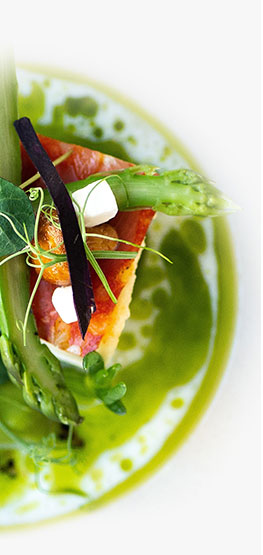
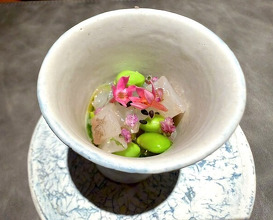
I visited "Japan no Italian Ryori Ten sai" in Nagoya, near Tsuruma Park, just a short walk from Tsuruma Station.As the name suggests, this Italian restaurant focuses not just on traditional Italian cuisine but also on Japanese ingredients and seasonal flavors, showcasing how to express them in Italian dishes.If I had to sum up my impression of this place in one phrase, it would be "a restaurant that keeps getting better as the meal progresses."In the beginning, the dishes were delicate, but as the meal continued, the layers of aroma, umami, and texture increased significantly, leaving me quite satisfied by the end of the course.We started with a dish of flounder carpaccio paired with a soup of edamame, cucumber, and white asparagus.The flounder had a strong umami flavor, complemented by the sweetness of the edamame and the acidity of the soup. The refreshing notes from the cucumber and white asparagus made for a light yet memorable start.Next was a sardine snack served with a sauce of paprika, green onions, and shiso.The sardine was tender and melted in my mouth. The balance of sweetness and saltiness was excellent, with a subtle hint of paprika. This was simply a delicious dish.The warm consommé soup featured ravioli stuffed with Nagoya Cochin chicken, made over two days.It had a deep umami flavor, with the essence of the chicken gently released from the ravioli. While it wasn’t flashy, it was comfortingly delicious, providing a solid backbone to the entire course.From here, the meal improved significantly.The cold capellini with blue crab was served with caviar and junsai (water shield).This was one of my favorites. The rich flavor of the crab combined beautifully with the saltiness of the caviar, clinging to the capellini like a flavor bomb. The crab meat itself was delicious, showcasing high quality as a cold pasta dish.The dish featuring Awaji conger eel was also impressive.The eel, steamed and then grilled, was fluffy and thick. It was paired with almonds, fennel, balsamic vinegar, and smoked oil.The eel's rich flavor melded with the umami of shiitake mushrooms, while the sweetness and acidity of the balsamic added a nice accent. The sauce enveloped the dish without being too heavy, allowing the eel's flavor to blend naturally with the elements, with the balsamic providing a subtle contrast. This was another delightful dish.The bread was also noteworthy.The focaccia topped with juicy tomatoes was delicious, and the onion bread had a lovely aroma and sweetness, making it memorable within the course.For the fish dish, we had charcoal-grilled sea bream.It was served with roasted young corn and zucchini, along with a bagna cauda sauce. The sea bream's flavor was straightforward, and the sweetness of the young corn shone through. The overall taste was gentle and aromatic, with a well-balanced presentation that didn’t overly manipulate the ingredients.The pasta misto featured sweetfish, grilled eggplant, scamorza cheese, and sansho oil.Using various shapes of pasta made for an enjoyable textural experience as I ate. The creamy aroma of the cheese enveloped the subtle bitterness and fragrance of the sweetfish, while the sansho oil tightened the overall flavor.The use of sweetfish was not overly Japanese, yet it worked well as an Italian dish. The pasta offered multiple textures, keeping it interesting throughout.The main course was charcoal-grilled sirloin from Mikawa beef.It was served with green beans, fresh pepper, and Cambodian rock salt. The sirloin had a robust meatiness, bursting with flavor with each bite. The fat was delicious, and the aroma from the charcoal was delightful. This dish allowed me to enjoy the balance of lean meat and fat.And then, things got even more interesting.One of sai's signature dishes is the truffle gelato.This dessert features a tart with truffle gelato and additional truffle, achieving a wonderful balance of sweetness and saltiness. The aroma of truffle was prominent, yet it didn’t compromise the dessert's integrity. The balance was superb, and it’s easy to see why this is a signature dish of the restaurant.Following that, the aglio e olio made with squid tentacle sauce was also excellent.The pasta was combined with Manji chili peppers and green chili, and the rich, creamy flavor of the aglio e olio paired well with the chili's aroma. The chili flavor was not overpowering, and the harmony between the squid's umami and the oil was strong, making it a powerful closing pasta dish.For dessert, we had a cake made with figs from Anjo, coconut, and dried figs, along with fig leaf ice cream.The soft sweetness of the figs paired beautifully with the coconut, and the cake had a depth of sweetness that was very pleasing. It wasn’t flashy, but it left a lovely aftertaste. The fig leaf ice cream also had a nice aroma, tying the whole meal together.The petit fours included baci di dama, hojicha, lemon zest, and meringue.Even the petit fours were thoughtfully prepared, maintaining the course's focus until the very end. Such attention to detail enhances the overall impression after the meal.Overall, while the beginning was good, I personally found that the course improved significantly in the latter half, especially with the cold capellini with blue crab, Awaji conger eel, sweetfish pasta misto, truffle gelato, and squid aglio e olio.When it comes to Italian cuisine using Japanese ingredients, it can sometimes lean too much towards Japanese flavors or rely too heavily on the ingredients themselves, but sai strikes a great balance.Using Japanese ingredients and aromas, it firmly lands in the realm of Italian cuisine. I particularly appreciated the sensibility in layering umami, aroma, saltiness, and acidity.Among Italian restaurants in Nagoya, this one stands out with a unique character.This course truly lived up to the banner of "Japanese Italian cuisine," with satisfaction increasing as the meal progressed.
We use cookies on this site to enhance your user experience.