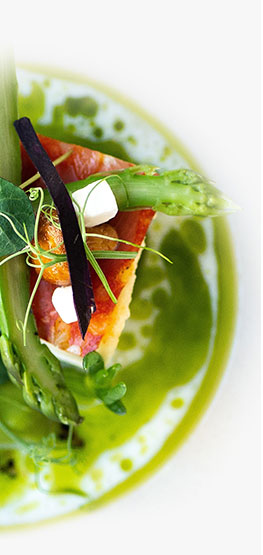
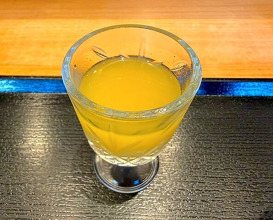
I visited the Michelin two-star Japanese restaurant "Otaki" located in Takamine, Kyoto.Nestled in the quiet area of Takamine, a bit away from the center of Kyoto, this standalone house is run by Chef Kazuaki Baba, who honed his skills at "Torii-moto" and "Wakuden" before opening his own restaurant in 2012. Since relocating to its current location, Otaki has received high praise for its innovative dishes that blend traditional Kyoto cuisine with seasonal ingredients from Kyoto and local farms, earning it two Michelin stars.On this day, I enjoyed an omakase course featuring abundant summer ingredients.First, I was served a fresh juice made from pineapple and citrus.The refreshing acidity of the citrus combined with the natural sweetness of the pineapple instantly revitalized my slightly fatigued body from the summer heat. The aftertaste was surprisingly light, naturally heightening my anticipation for the upcoming course.Next came a dish of tomato jelly, shiso tofu, and caviar from Latvia.The juicy acidity of the tomato and the gentle sweetness of the shiso tofu harmonized beautifully with the saltiness and umami of the Latvian caviar. Each element complemented one another without clashing, resulting in a dish that was both refreshing and elegant, perfectly embodying the essence of summer.The soup course featured a broth made from soft-shelled turtle, with abalone and eggplant.I was first amazed by the richness of the turtle broth, which was thick and flavorful yet not heavy, with a clear taste free of any off-flavors.The abalone released its umami with each bite, while the eggplant, having absorbed the broth's essence, was exceptional. It soaked up the soup like a sponge, bursting with flavor in my mouth. It's rare to find a soup course that provides such a high level of satisfaction.The sashimi of meita-garei was served with soy sauce and ponzu.The flesh was moist and firm, releasing a refined sweetness with each bite. The soy sauce enhanced the fish's umami, while the ponzu added a refreshing acidity, dramatically changing the dish's profile. The accompanying liver was rich, adding depth to the white fish.Next was a vinegared dish of junsai.The pleasant texture and smooth mouthfeel were delightful, with a mild acidity. While it wasn't flashy, it played an important role in balancing the flow of the entire course.The sesame-dressed dried cucumber, shiitake mushrooms, and kikurage (wood ear mushrooms) were next.The rich flavor of the sesame combined with the crispness of the dried cucumber and the crunchy texture of the kikurage created a delightful interplay of textures. The addition of shiitake umami brought a depth of flavor that exceeded its appearance.Then came a dish of red sea urchin with kombu broth jelly.The rich sweetness of the red sea urchin was beautifully complemented by the kombu jelly, which did not overpower the sea urchin's natural sweetness and oceanic aroma. The combination enhanced the umami of the sea urchin, showcasing the high quality of the ingredients through its simple composition.Next was grilled eel sushi.The eel, slow-cooked to perfection, was tender and flaky. Its fat was refined and not greasy, releasing the eel's inherent umami with each bite. The harmony with the vinegared rice was remarkable, making it a highly satisfying piece of sushi despite being just one.The clam with sweet miso was next.The sweet miso enveloped the clam's umami, creating a delicious dish. With each bite, the clam's deep flavor spread, followed by the refreshing acidity of the sweet miso lingering pleasantly.Then came the salt-grilled sweetfish from Azumigawa in Shiga Prefecture.The fish was grilled to a plump finish, allowing me to enjoy it whole from head to tail. With each bite, the unique aroma of the sweetfish emerged, and the slightly bitter innards added a summery flavor. The flesh was firm and rich, allowing me to fully appreciate the refreshing and robust umami typical of river fish.The hamo (pike eel) udon was made with noodles infused with plum paste.The delicate umami of the hamo paired beautifully with the refreshing acidity of the plum-infused udon. The noodles had a nice chewiness, releasing the aroma of plum with each bite. The combination of hamo and plum was perfect. The broth was also exceptionally well-crafted, making me want to savor every last drop.For the meat course, I had the smoked and grilled fillet of Hiraigyu from Kameoka.The remarkably tender fillet released the rich umami of the red meat with each bite. The smoky aroma from the straw grilling enhanced the meat's sweetness without overpowering its natural flavor. The cooking was exquisite, showcasing the delicate touch typical of a Japanese restaurant. This was truly delicious.Then came the rice.The rice for the day was Hitomebore from Miyagi Prefecture.The grains were beautifully separated, each plump and fluffy. The natural sweetness of the rice spread with each bite, making it satisfying on its own.The accompanying kombu and clam furikake was also exceptional. The concentrated umami of the clams and the deep flavor of the kombu further enhanced the rice's sweetness, making it irresistible.To finish, I ordered a half-cooked egg rice bowl and a combination of hayashi rice.The rich creaminess of the half-cooked egg paired with the deep umami of the slowly simmered hayashi rice created a playful dish that, while a Japanese finale, also carried a touch of Western familiarity, characteristic of Otaki.For dessert, I had grape jelly and matcha pudding.The grape jelly had a refreshing sweetness with a fruity juiciness, making it perfect for after a meal.The matcha pudding was smooth with a hint of bitterness from the matcha, balanced by a rich sweetness. It provided a pleasant conclusion to the course.Otaki skillfully incorporates playful elements such as Latvian caviar, smoked grilled dishes, and hayashi rice while firmly grounding itself in the techniques of Kyoto cuisine.While each dish was impressively crafted, what stood out even more was the beauty of the overall flow of the course. Starting with refreshing dishes, building layers of umami with a sense of rhythm, filling up with rice, and finishing lightly with dessert. The structural elegance truly reflects its two-star status.Although it is a bit of a distance from the center of Kyoto, it is undoubtedly worth the trip to Takamine.I thoroughly enjoyed the unique Kyoto cuisine of Otaki, which respects tradition while breaking free from conventional ideas.
We use cookies on this site to enhance your user experience.