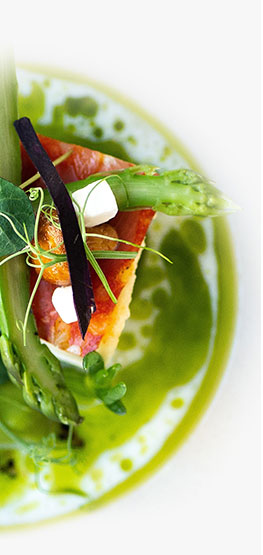
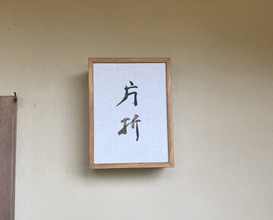
To wrap up June, I finally visited Kataori, a place I had long admired.Earlier this month, I had the chance to go to Kisaki, and now I’ve made it to Kataori.It’s a dream come true to visit two Japanese restaurants I’ve always wanted to experience in just one month.Now that I’ve finished my meal, the first thought that comes to mind is:I’m so glad to have been born in Japan.I’m grateful to have been born in this era.I’m thankful for the opportunity to visit this restaurant.And I’m just glad to be alive.This place made me feel all of that.Honestly, I believe it’s the pinnacle of Japanese cuisine I’ve ever had.It’s not just about the food.The beauty of this restaurant reveals itself in the smallest details.The owner never lets the sleeves of her kimono touch the counter.The movements of the apprentices are graceful and confident.The counter remains spotless until the very end.Even the time spent outside of the meal becomes a form of art.And the first surprise was the oshibori (hot towel).It was so hot that I almost gasped.As soon as I placed it on my neck, my body relaxed instantly.Perhaps the meal began with this single oshibori.They say temperature is crucial in Japanese cuisine.This restaurant embodies that principle like no other I’ve experienced.The warm dishes arrive steaming hot.Even a few seconds can change the temperature, yet they convey a desire for you to enjoy the food at its most delicious moment.The first dish was white shrimp.Visually, it was astonishingly serene.But as soon as I took a bite, that tranquility shattered.The seaweed was unbelievably light and fragrant.The white shrimp on top was so tender it melted in my mouth, leaving only sweetness behind.What surprised me most was the lingering aftertaste.The sweetness and aroma continued for dozens of seconds after finishing.It felt less like eating a dish and more like a scene etched in my mind.I also can’t forget the sea urchin somen served in a bamboo vessel.The richness of the sea urchin.The coolness of the somen.That alone was delicious, but as I continued eating, I noticed something.Layers of flavor: miso, sea urchin, somen, and perilla.I also noticed a small piece of yuzu peel floating in the clear soup.That subtle aroma tightened the overall flavor.This is what it means for a dish to be designed even in the unseen details.Then my father couldn’t help but smile at the oysters.First, I took a sip of the broth.The umami of the sea quietly spread, warming my body.Then came the oyster.It was the largest and most delicious oyster I’ve ever had.Incredibly thick yet without any fibrous texture.The word "plump" doesn’t do it justice.It was rich like milk, gently melting on my tongue.I understood why my father smiled so easily.This isn’t a dish that masks ingredients with seasoning.Can ingredients be made this delicious?That’s why I was reminded of the true meaning of the Japanese phrase "itadakimasu."To receive life.To be grateful for the ingredients.To be thankful for the chefs.These are words we often say without thinking, but I felt their weight.For the final rice, there were four varieties:Kanazawa dashi rice.Tempura rice bowl.Marinated horse mackerel rice.Plum tea porridge.Each was so delicious that I didn’t want it to end.I felt like I could eat ten more servings.White rice, beef simmered in soy sauce, pickles, and miso soup.So simple, yet I feel like I could eat it forever.It reminded me of the nostalgia that resides in the hearts of Japanese people, rather than just luxury.Finally, there was the minazuki yokan (sweet jelly).It had a refined aftertaste that didn’t assert its sweetness.The moment I took a sip of freshly whisked matcha, I realized how meticulously planned this course was.From start to finish, it was truly perfect.And I learned something else this time.Every time the owner explained a dish, stories of Kanazawa’s history and the Warring States period naturally emerged.I realized I still know so little about Japan.Learning about food means learning about history, culture, and people.I want to know more about Japan.I want to study more.Eating a meal is also about consuming knowledge.I love cuisines from all over the world.I want to continue visiting many countries and tasting their food.Yet, I can proudly say that Japanese cuisine is the best in the world.Not in flashiness, but in tranquility.Not in strong flavors, but in listening to the voice of the ingredients.I feel there is no other culture as delicate, beautiful, and profound as this.In closing,This is something I always remind myself:Life is only once.So every meal is a once-in-a-lifetime experience.Being born.Being born in Japan.Having the opportunity to enjoy such wonderful cuisine.The people who cultivate the ingredients.The chefs who elevate life into cuisine.I want to live without forgetting my gratitude for all of this.And through food, I hope to meet many people, learn about many cultures, and enrich my life.It was a great meal.
We use cookies on this site to enhance your user experience.