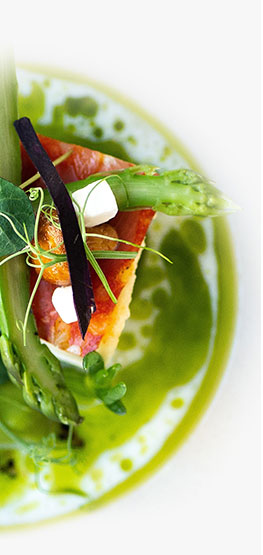
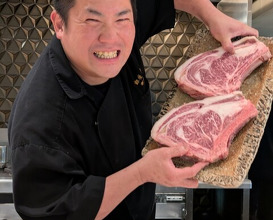
This review is for those who haven't been yet.Our restaurant, known for being a favorite among hearty eaters, has always piqued my interest. However, as someone with a small appetite, I hesitated for a long time. Strangely enough, I often heard the restaurant's name from chefs and customers at other places, with some even asking, "I've been curious about it, but I'm not sure I can finish the meal. Is that okay?" So, I finally decided to give it a try.The result? Just as the rumors suggested, it truly caters to hearty eaters!First, the portion sizes. In addition to the standard "medium" size, you can choose "small," "large," or "extra large" for each dish, all at the same price. This system is a blessing for hearty eaters, and many customers opted for the "extra large" portions.Next, the number of dishes. The course consists of 13 items, which is quite substantial, and you can add an extra dish before the main course for an additional charge. Since these are high-end specialty dishes, it's definitely worth trying, but you'll need to consider your budget and appetite.The course begins with finger foods and appetizers, creating a lively start. Then, there’s a significant shift in the middle with the appearance of seasonal dishes. After the seasonal dish, the extra charge specialty arrives, which is enough to satisfy your hunger. However, hearty eaters are different; they show their strength with the main meat dish, the finishing risotto, and even a final dish after that, demonstrating a clear difference in capacity compared to the average diner who orders a "small." The course concludes with two desserts.The generous pricing allows two people to eat for the same cost, so for hearty eaters, I would rate it a solid "5" with an overall evaluation of "+1." However, since the price remains the same even if you can't finish a single portion, it can feel a bit disappointing, even if you know it's a good deal.\[Genre\] French \[Chef\] Yoshikazu Oishi \[Price\] JPY 31,900 (tax included, no service charge) \[Menu\] None \[Atmosphere\] The seating is an L-shaped counter, resembling more of a Japanese or sushi restaurant than a French one. The cooking takes place against the wall behind the counter, while plating is done in front, allowing you to enjoy the cooking process. Many regulars, especially hearty eaters, frequent the place, and while there are fewer first-time visitors and foreigners, the chef is attentive to newcomers and those with smaller appetites. The atmosphere feels more like an izakaya than a French restaurant, but it’s not chaotic; rather, it has a lively and energetic service style.\[Pace\] Medium pace. \[Service\] The chef's skill in handling customers is outstanding, making the service chef-centric. Of course, the staff handles food delivery and drink orders. \[Usage Scene\] Since it’s a counter, it’s suitable for 1 to 3 people, and the close proximity of seats may not be ideal for business meetings or dates. \[Wine\] In addition to wine, various alcoholic beverages are available. For glass wines, aside from the glass champagne priced at JPY 3,200, there are no listed options or prices for wines on the drink menu. For pairings, starting with champagne, the selection includes white wine, rosé, red, and Japanese sake, totaling 10 glasses. When ordering by the glass, recommendations will be made based on your timing. They often use inexpensive white wines priced between JPY 3,000 and 5,000, which is not bad. However, the red wines (around JPY 15,000) are less impressive, and the lack of options for red is a drawback.1. Butter tea…△ A warm welcome drink, nice for winter but not suitable for hot days. 2. Osetra caviar, scallops, firefly squid… Finger food with plenty of caviar. 3. Osetra caviar, red sea urchin, small shrimp…〇 4. Bordeaux white asparagus, cherry salmon, wild vegetables, sansho sauce (medium portion)… Softly finished white asparagus. 5. Truffle soup under a foam of mushrooms, onsen egg…〇 A rich, classic soup. 6. Bread, butter… With the large course size, just a taste of the bread. 7. Hassun (small portion)… A hassun reminiscent of "Ginza Shinohara," with a Japanese-style seasoning. Jelly of vegetables, chicken, bamboo shoots, turban shell, abalone with liver sauce. 8. Green asparagus from Kagawa, under aurora sauce with hairy crab from Hokkaido. 9. Foie gras monaka, strawberries…△ Similar to "Ginza Shinohara," but the strawberries are unnecessary. It’s also disappointing that there’s no pairing (with sweet sake or dessert wine). 10. Baked red sea urchin in pastry (half portion)… Additional charge of JPY 5,000 (excluding tax). Using 2/3 of the red sea urchin from Fukuoka, priced at JPY 6,500 per box, mixed with akamoku from Bima Island, Fukuoka, and finished with béchamel sauce. Since it’s in pastry, this can fill you up quite a bit. 11. Refreshing palate cleanser with watermelon from Kochi. 12-1. Matsusaka beef, red wine sauce (medium portion)…△ A bit dry and not as delicious as expected. 12-2. Matsusaka beef fat (small portion)… Added fat midway. As the chef explained, this is tastier. 13. Risotto, tempura, shrimp soup (half portion)…〇 The soup is delicious. 14. Curry rice (half portion)…× The idea of curry rice in French cuisine is why I hadn’t visited before. No butter used, and while there’s beef, it’s blended into a soup, resulting in a light and refreshing curry. If you close your eyes and taste the soup (roux) without considering the course's context, you can tell it’s a very well-made curry soup. It’s not the kind of curry rice I imagined (that hearty eaters would devour). Still, having curry after the finishing risotto and before dessert is too much. As a side note, I was surprised to see a hearty eater order eight portions (16 times the photo!). 15. Loquat, white wine sorbet…〇 16. Cheesecake with cherry blossoms, Yame tea ice cream (half portion)…× The flavor is somewhat Japanese. It’s hard to enjoy this color combination while watching lions.
We use cookies on this site to enhance your user experience.