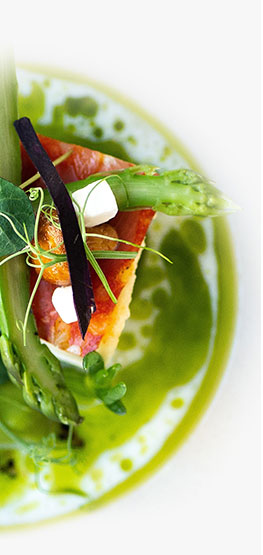
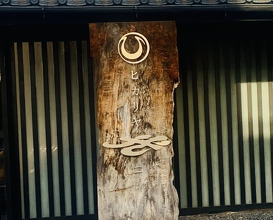
First VisitThis is a series where I visit restaurants certified by the Ministry of Agriculture, Forestry and Fisheries, specializing in local produce from French, Italian, and Spanish cuisines.I made a reservation for a 1900 JPY seat on Tabelog two weeks in advance, hoping to enjoy wild vegetables.Located along the Zenkoji Kaido (National Route 143), this restaurant features an impressive main building (the main house) which serves Japanese cuisine as "Hikariya Higashi." The entrance is in a cozy building next door, leading to the kitchen and dining areas that have been renovated from an old storehouse. The site also houses several tangible cultural properties, similar to Niigata's "Nabe Chaya Korin," but our restaurant has undergone more thorough renovations.After enjoying a welcome herbal tea (made from fragrant olive, butterbur, wild pear, and jujube), I was shown to a private room on the second floor (nicknamed the "Sakura Room," where you can enjoy cherry blossoms in spring).The dishes presented were:1. Amuse-bouche 1: No description - Hairy crab tart with Shinshu black caviar and jujube2. Amuse-bouche 2: Sweetfish - Tenryu sweetfish spring rolls with perilla, cucumber, and melon3. Cold appetizer 1: Artisan - Salad of 40 types of Shinshu vegetables, fried Chardonnay sprouts, served with "Yatara" (a local dish from northern Shinshu)4. Warm appetizer 1: Shiitake - Shiitake and shallot terrine, consomme soup made from iwana (char), truffle oil, and musk thyme leaves5. Warm appetizer 2: Wild vegetables - Chicken consomme with rice from "Sun and Earth" and a risotto of 57 types of wild vegetables and herbs, topped with parmesan espuma6. Warm appetizer 3: Celery root and truffle - French celery root baked with truffle, served with celery root and truffle cream sauce7. Palate cleanser 1: Lettuce - Lettuce tower with two types of zucchini (yellow and green), served with a sansho oil sauce8. Fish: Shinshu carp - Carp ravioli with ricotta, morel, and walnuts, served with lacto-fermented mushrooms and vegetable sauce9. Meat: Wild boar - Coarsely ground wild boar meat with mountain vegetables (tara no me and butterbur) hamburger, topped with brown mushrooms and green asparagus in bearnaise sauce, served with two sauces (fermented garlic oil and fermented strawberry puree)10. Palate cleanser 2: White asparagus - Abalone meat and liver in a pheasant consomme soup with white asparagus, topped with purple shiso11. Dessert 1: No description - Crème brûlée with cauliflower and white chocolate cream, coconut and basil oil ice cream12. Dessert 2: Hassaku - Cassata (ricotta, nuts, dried fruits, and sake lees ice cake), Meyer lemon mousse, elderflower jelly, topped with hassaku and parsley13. Petit four: No description - Visitandine (a traditional pastry from Lorraine, France) with burnt butter and chocolate flavor, made with Shinshu buckwheat - Herbal tea: Original blend with fragrant olive and Uwamizakura, served with syrup containing UwamizakuraThe stay lasted about three hours.Total: 28,000 JPY (22,000 JPY for dinner and 6,000 JPY for five non-alcoholic pairings), which is quite reasonable without service charges, although the private room fee was also included.Here are my impressions of the dishes:* Overall, I was impressed by the continuous presentation of noteworthy dishes.- The ingredients mainly featured Shinshu vegetables, wild vegetables, and river fish, except for the hairy crab, truffles, celery root, and abalone. While the flavors may not be as strong, I would have preferred to use Shinshu truffles.- The first dish surprised me with caviar, which turned out to be from a sturgeon farmed near Lake Shirakaba. The caviar was medium-sized, likely from the Ossetra variety, with a more delicate saltiness compared to imported ones. I was told that the caviar would be ready in a few years when I tasted it in Iida in 2019, but it seems they succeeded in 2021.- The second dish featured Tenryu sweetfish, considered the pinnacle of farmed sweetfish. Perhaps because it was a young fish, the spring rolls with cucumber and melon were a bit excessive, overshadowing the sweetfish's natural aroma. I would have preferred more complementary ingredients to highlight its flavor. [-0.1]- The third dish was an impressive salad. "Yatara" consists of finely chopped summer vegetables like cucumber, eggplant, and myoga, seasoned with miso or soy sauce. It’s interesting that while the ingredients are similar to Yamagata's "dashi," "yatara" seems to be more focused on preservation due to the lack of coastal access.- The fourth dish was the chef's signature dish. The combination of iwana consomme and shiitake was incredibly flavorful and concentrated.- The fifth dish was a fitting finale for this expedition. The risotto, made with 57 types of wild vegetables and herbs, was beautifully balanced by the chicken consomme and parmesan. It was a remarkable dish.- The sixth dish was delicious but not suitable for eating with a fork and knife. It’s best enjoyed by hand.- The seventh dish was visually simple yet impactful, evoking a sense of modern art. The flavor of the sansho sauce was innovative.- The eighth dish was the most French-inspired but also the most disappointing. The texture of the ravioli didn’t quite hold together. [-0.2]- The ninth dish was equally impressive as the fifth. While it resembled the amuse-bouche from Niigata's "Wozen," this dish was more focused on the main ingredients. It likely underwent low-temperature cooking for a rare texture, skewered on a branch of Tamushiba (with a strong citrus and spicy flavor), paired with fermented garlic and strawberry puree for a unique combination.- The twelfth dish featured hand-prepared hassaku, which must have taken an incredible amount of effort.- The non-alcoholic pairings were also of high quality. Personally, I consider Niigata's "Wozen," Yamanashi's "Restaurant SAI," and this restaurant as the top three. They all share a commonality in utilizing fermentation techniques with kombucha.- The five drinks included a bonus with a fragrant oil infusion.- Since we had also enjoyed fragrant oil the day before, the sommelier manager enthusiastically explained about Tamushiba, adding Uwamizakura to the herbal tea... it was a delightful conclusion.- The manager seems to be an active person who personally forages for fragrant oil and Uwamizakura in the mountains, exhibiting skills comparable to a top bartender.As a souvenir, I received:- Japanese sweets, bonito and kombu furikake- Relais & Châteaux guidebook #3 and #4 * I passed on the latter due to being on a budget.I left the restaurant at 21:50, feeling quite satisfied. This dining experience fulfilled my personal interests. If I were to rate it, I would give it a solid 4.5. I also learned that Uwamizakura can be pickled and used in furikake or chazuke, so I look forward to visiting the Japanese cuisine section, "Hikariya Higashi."
We use cookies on this site to enhance your user experience.