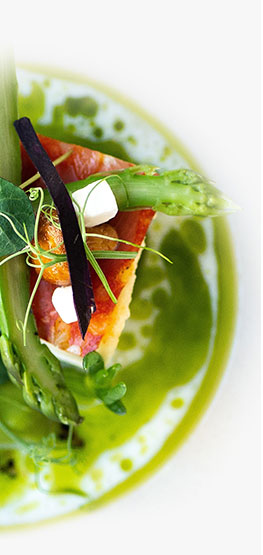
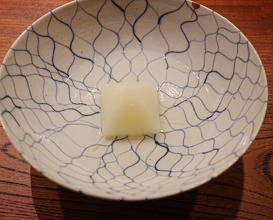
Nestled in a quiet alley of Nishi-Azabu, the Japanese restaurant "Myoujyaku" proudly displays its noren (curtain). Currently holding three Michelin stars, the essence of this establishment is encapsulated in its name. "Myou" means light, while "jyaku" signifies tranquility and the subtle beauty of wabi-sabi. Together, they create a world where the contours of the ingredients brightly emerge from the silence. This philosophy is consistently reflected in the dishes, which focus on water and salt, illuminating the inherent flavors of the ingredients without layering unnecessary tastes. It is truly a bright yet subdued flavor. The restaurant's name and its cuisine quietly connect to form a singular world.Here, the focus is not on technique but on water, salt, and the ingredients themselves. However, this is not merely a matter of subtraction. In recent years, the phrase "bringing out the ingredients' essence" has been frequently used in Japanese cuisine, but the dishes at "Myoujyaku" take a slightly different approach. Rather than merely extracting the flavors, the cuisine encourages diners to discover the inherent deliciousness of the ingredients themselves. To achieve this, unnecessary seasonings are eliminated, and even the aftertaste is incorporated as part of the flavor.This philosophy is vividly conveyed from the very first dish, "Turnip." Diners first savor the center of the turnip, followed by its broth. The sweetness of the turnip lingers in the mouth, merging with the broth to complete a single dish. The impression left after swallowing is even more memorable than the time spent eating the turnip itself. This is what it means to design an aftertaste, and it is truly impressive. The subsequent dish, "Abalone," features a combination of raw, simmered, and liver preparations, along with a smooth abalone puree. Each preparation expresses the ingredient at different temperatures and textures, ultimately allowing the outline of the abalone to emerge clearly. Despite layering the dishes, the flavors become increasingly pure.The "Sashimi of Akashi Sea Bass and Aori Squid" is also a symbolic dish. The sea bass is served with a saltwater made from simmering its bones in water. This is akin to seasoning the sea bass with itself. The Aori squid is accompanied by a squid salt made from its flesh. There are no soy sauce or wasabi. The sea bass is particularly remarkable, with a texture that belies its freshness, as if it had just been caught that morning. By finely slicing the fish, the tension in the flesh is released while simultaneously increasing the surface area to enhance its aroma. The vitality of the live fish remains, yet what spreads in the mouth is only the clear umami and fragrance.The "Miso Soup with Shiitake and Aina-me" further deepens the understanding of this restaurant's essence. The broth consists solely of water and salt. First, a sip of the broth is taken, followed by tasting the shiitake, and then back to the broth. Next, the Aina-me is tasted, and again back to the broth. With each sip, the umami experienced changes. When the aftertaste of the shiitake lingers, the Aina-me emerges, and when the Aina-me's aftertaste remains, the shiitake comes to the forefront. Rather than constructing flavors, the memory left in the mouth illuminates the next taste. The aftertaste itself becomes a seasoning.The "Wara-grilled Striped Horse Mackerel" showcases the presence of thickly sliced fish. It is paired with thinly sliced lotus root pickled in lemon. The rich fat of the striped horse mackerel is complemented by the light texture and citrus acidity of the lotus root. The acidity does not cut through the fat but rather enhances its pleasantness. On the other hand, the "Hairy Crab and Young Corn" features a dumpling filled with crab meat, enriched with crab miso, submerged in a puree of young corn. The initial bite reveals the strength of the crab, followed by the gentle sweetness of the young corn.The "Silk-Wrapped Sushi" is a dish thoroughly constructed around the context of sweetfish. The vinegared rice is mixed with chopped fresh herbs that accompany the sweetfish, layered with the roasted aroma of the fish. Fish sauce is brushed on, and the sweetfish is fried and then layered with a smoky aroma from charcoal, finally wrapped in a thin omelet. The roasted sweetfish provides umami, while the fried sweetfish contributes fragrance. Each component has a distinct role, yet when all three are taken together, they form a singular sweetfish dish. Moreover, by intentionally not aligning the ends, the flavors of the roasted, fried, herbs, and fish sauce change with each bite. It is a remarkable design that deconstructs the charm of the sweetfish and reconstructs it in the mouth. The "Water Shield" is a dish paired with a new ginger sauce. Using fresh ginger with the skin on, lemon and sudachi juice are layered. Placed after the sweetfish sushi, it refreshes the palate like high-quality gari (pickled ginger). It serves not merely as a palate cleanser but as a bridge to the next dish, absorbing the aftertaste of the sweetfish.The "Young Corn with Baby Squid" is visually striking, resembling a black mass. The baby squid is deep-fried in its ink, allowing diners to enjoy the flavor without staining their mouths. The taste is robust, creating a clear contrast in the otherwise quiet course. The second half features young corn hairs that are fried into a fluffy texture. The crispy texture and roasted aroma rise up, illuminating not only the center of the ingredient but also its surroundings.The "Tsubugai and Clams" consists of thinly sliced Tsubugai topped with a broth of clams, asari, and shijimi. This dish stands on its own without relying on seasonings, solely utilizing the saltiness and umami of the shellfish. While the flavor is subtle, the umami of the shellfish expands with each bite. The following dish, "Eggplant and Somen," features fried eggplant served with a smooth sauce. The aroma and richness of the oil-coated eggplant cling to the somen, creating a strong contrast in the course.The "Grilled Duck" is a straightforward dish that relies solely on salt and charcoal. The surface is infused with the aroma of charcoal, while the center retains a glossy red meat. With each bite, the umami of the duck unfolds. The salt shapes the contours, while the charcoal imparts fragrance. The subsequent "Duck Tsukune" is prepared without binders, allowing the meat's umami to dissolve directly into the broth. While the grilled duck offers the pleasure of its aroma, this dish allows diners to savor the essence of the duck.The meal begins with "Nihibana." The freshly cooked rice has a youthful appearance, still holding moisture, with its aroma and sweetness gently rising. Following this, "Pickles" are served, leading to "White Rice." Next comes "Stewed Goby," "Sea Bream with Sesame Furikake," "Bonito," and "Dried Baby Sardines." Each accompaniment is enticing, yet throughout the meal, the rice remains the star. Despite feeling full, my chopsticks do not stop.Dessert begins with "Chilled Blueberry Soup." The combination of blueberries and sweet red bean paste may seem surprising, but considering the compatibility of strawberries and sweet red bean paste, it makes sense. The acidity of the fruit lightly elevates the sweetness of the paste, landing refreshingly as a chilled soup. The following "Zunda Dorayaki" features a chewy skin made from mochi flour, with the fresh aroma and gentle sweetness of edamame. It allows diners to enjoy the individuality of the ingredients until the very end.Chef Nakamura's cuisine is consistently characterized by a vertical approach to ingredients. Rather than spreading flavors horizontally, the turnip goes to the turnip, the abalone to the abalone, and the sweetfish to the sweetfish, delving into the depth of each ingredient. Starting from water and salt, the umami, aroma, bitterness, and aftertaste within are quietly brought to the surface. What lingers after the meal is not a strong memory of flavors but the sensation of the ingredient's contours brightly emerging. Just as the name "Myoujyaku" suggests. This aftertaste makes me want to head back to Nishi-Azabu once more. It was a great meal.
We use cookies on this site to enhance your user experience.