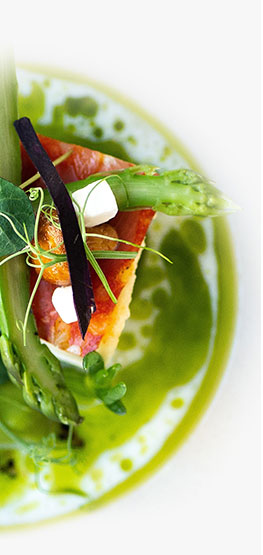
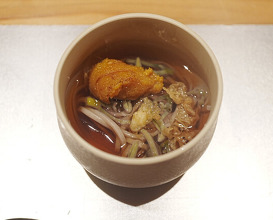
Nestled quietly in the serene streets of Nishi-Chiba, Sushi Ei has been serving sushi since its establishment in 1967. After over half a century of history in Higashi-Chiba, it relocated to its current location in Nishi-Chiba in August 2021. The second-generation owner, Chef Sato Katsuhiro, showcases his skills in a refined space centered around the counter. He has built relationships with fishing ports and producers across the country, establishing a unique sourcing method that does not solely rely on Toyosu. Based on traditional Edomae techniques like aging and finishing, he creates dishes that allow for comparisons, bold portions, and even incorporates brandy and daiginjo into his cuisine. Over half a century of history has culminated in the creation of sushi that is uniquely his own.The course begins with "Soba." The smooth texture of the soba noodles is complemented by the rich sweetness of sea urchin and the aroma of the buckwheat, all tied together by the dashi. While it appears refreshing, the umami of the sea urchin is surprisingly robust. The "Hanazaki Crab" from Nemuro is a rich dish with shredded meat generously coated in crab miso. With each flake of meat, sweetness emerges, and the richness of the crab miso enhances the flavor profile. The generous portion adds to the satisfaction. Next is the "Purple Sea Urchin." The rich sweetness of the sea urchin is layered with sticky red meat and rice, all brought together by a strong sauce. The umami of the sea urchin, the flavor of the red meat, and the sweet and spicy sauce create a powerful dish.The chef's expertise is most clearly displayed in the flow of presenting the "Mako Flatfish" in four different styles. First, a comparison between "Freshly Caught Mako Flatfish" and "Three-Day Aged Mako Flatfish." The fresh catch has a firm texture and clear flavor, while the aged fish has a sticky texture and a deeper umami. Additionally, the "Mako Flatfish Liver" is prepared with a rich sauce and served with wakame. The aroma of the ocean combines with the richness of the liver, showcasing a different strength than the fish itself. The "Seared Edge" highlights the sweetness and aroma of the fat. Rather than solely focusing on freshness, the chef presents the allure of the fish through time, cuts, and cooking methods, creating an interesting composition. The following "Echitoku Shell" offers a crunchy texture with a gradual sweetness.Next, a comparison of abalone, shrimp, and karasumi. The abalone is presented in three forms: "Column," "Liver," and "Super Thin Slices," showcasing differences in cuts and parts. The column has a firm texture, the liver is rich and dense, and the super thin slices have a delicate mouthfeel when enjoyed with dashi, each offering a unique charm. The shrimp includes "Striped Shrimp," "Demon Shrimp," and "Gas Shrimp." With clear sweetness, strong elasticity, and a sticky richness, each shrimp has a distinct personality. The "Karasumi" is prepared using different types of sake, including brandy and daiginjo, allowing for a comparison of aromas and aftertastes. The chef's curiosity is reflected in the structure that compares not only the ingredients but also the cuts, types, and preparations.The nigiri starts with "Squid." The delicate knife work brings out the sticky sweetness, while the firm rice provides structure. Next is "Nodoguro," which is seared to release the fat, transitioning from aroma to sweetness. The "Nodoguro Simmered" changes its expression to a sweet and savory flavor, showcasing a different charm from the nigiri. The "Kinmedai Shabu-Shabu" is lightly cooked to open up the flesh, transforming the fat into aroma. The final piece, "Katsu" from Kesennuma, is marinated to enhance its iron-rich umami, creating a harmonious strength.From here, the course features tuna from Yamako. The "Marinated Tuna" retains the acidity and density typical of red meat while absorbing the umami of the sauce. The "Chutoro" has a perfect balance of red meat and fat, melting smoothly in the mouth, while the "Otoro" melts at tongue temperature, with the firmer rice supporting its richness until the end. Marinated, chutoro, otoro—a classic relay of tuna that gradually elevates from umami to fat.The "Mackerel" is wrapped in nori, with the thickness of the fat balanced by the aroma of the ocean. The following "Mako Flatfish" features a piece layered with seared edge and liver. The sweet richness of the fat and the depth of the liver are complemented by the aroma of the sear. The "Horse Mackerel" is softened by delicate knife work, releasing fat and umami with each bite. The "Sea Urchin" is served generously on gunkan, with rich sweetness and ocean aroma flooding the palate, maintaining the course's intensity even towards the end.The "Botan Shrimp" is lightly seared to enhance its aroma, adding a toasty note to its sticky sweetness. The "Kohada" is finished with a hint of vinegar while retaining the fish's umami. The "Noto Sea Eel" is wrapped in nori, enveloping its strong fat and rich umami in ocean aroma. Finally, the "Anago" is prepared with salt and simmered, showcasing two expressions. The salt enhances the aroma, while the simmering adds sweetness and richness, both of which melt in the mouth. In other words, it’s a melting anago.The course concludes with "Tamago," which is layered by separating the egg whites and yolks, incorporating wine and honey. The beautifully layered cross-section adds a soft sweetness and aroma to the richness of the egg, wrapping up the course with the chef's unique creativity.The charm of Sushi Ei lies in its ability to expand the possibilities of sushi through the chef's own sensibility, without relying on its over half-century history. From fresh to aged, flesh to liver, raw to seared, and even incorporating sake into the preparations, each ingredient is explored in multiple ways. This accumulation creates new discoveries with every bite. There are plenty of reasons to visit Nishi-Chiba. I look forward to seeing what comparisons the chef will create next and what surprises await in the next piece. Thank you for the wonderful meal.
We use cookies on this site to enhance your user experience.