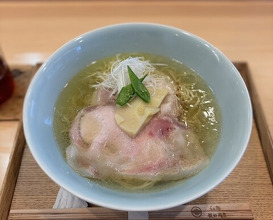
A super famous ramen shop that many people know, even if they are not ramen enthusiasts. It is rated as the best ramen restaurant in Japan on Tabelog (as of a certain date in May 2026). I've relied on their instant ramen many times, but I had to try it in the restaurant itself.Reservations are made through OMAKASE, and the booking battle for Sunday at 4:00 PM is quite intense. I managed to secure a spot for Saturday at 2:00 PM during Golden Week after three attempts, perhaps because they had more operating days than usual.After enjoying an early eel meal in Odawara and a sauna, I arrived at the restaurant feeling refreshed. Since I was on a food tour, I took a taxi directly to the shop, confirmed my reservation outside, and purchased my meal ticket. I wanted to focus on the noodles and broth without any toppings, so I ordered the normal shoyu ramen and shio ramen, each priced at JPY 2,100. I was asked for the order, and I chose shio first, followed by shoyu.At 2:00 PM, it was time to enter the restaurant. I was seated at the counter, right in front of Mr. Iida himself, who greeted each guest properly. As many have noted, the other chefs were bald and dressed in traditional attire, while the waitresses wore kimonos, adding to the Japanese dining atmosphere.It seemed like almost everyone was on a food tour. The order of preparation was well thought out, showcasing excellent operation. The hand towels were not disposable but made of Imabari towels. And the best part? The cold water was Java tea, with a slight astringency that refreshed the palate.First, the shio ramen arrived. The broth was based on robust local chicken like Kuro Satsuma and Hinai, lightly enhanced with the umami of kombu. It created a complex harmony of flavors that couldn't be achieved with just animal-based ingredients. The broth was extremely clear and of high purity.The noodles were homemade, thin, straight, and had a silky texture with a nice chew. You could taste the sweetness of the wheat, and the synergy with the broth was delightful.The toppings included Tokyo X chashu, bamboo shoots, and snow peas, with white negi. Tokyo X is usually enjoyed in tonkatsu. The cooking technique truly maximized the rich flavor of the thick pork.The bamboo shoots added a spring aroma and slight bitterness.Next was the shoyu ramen. Compared to the shio, the soy sauce flavor was much more pronounced. The use of fresh soy sauce brought out the aroma and a hint of acidity. Personally, I preferred the shio for its more natural enjoyment of the broth and noodles.The noodles were nearly identical.The differences in toppings were nori, Kujo negi, and menma. The strong aroma of Kujo negi was only added to the shoyu, showing a meticulous attention to detail.Thank you for the meal.This restaurant is indeed said to be the most delicious in Japan. The quality of service easily surpasses that of a typical ramen shop, allowing for a focused dining experience. You can also feel the dedication to the ingredients, and it truly is delicious.However, considering the general price of JPY 2,100 (for the normal version) and the difficulty of making a reservation, one might question its value from an ROI perspective. There are other ramen shops that are easier to book and just as delicious, if not more so.That said, it’s true that I wouldn’t have made the trip to Yugawara without Iida Shoten. And if I hadn’t come to Yugawara, I wouldn’t have discovered the delicious restaurants and saunas in the surrounding area.It’s a truly valuable restaurant and experience that draws people in.
We use cookies on this site to enhance your user experience.