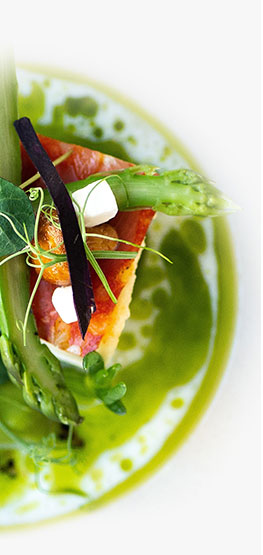
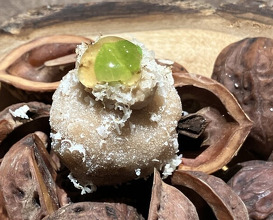
Revisit. Second time.Oshino Village, Yamanashi Prefecture.The genre is Innovative.This time, I visited with a friend, making it a party of two.We took a taxi from Fujisan Station, which cost about JPY 2,000.Last time, we were the only guests, but this time there were three groups totaling six people, including one group from overseas.The sommelier greeted us in fluent English.I was impressed not only by the chef's brother's extensive culinary skills but also by the sommelier's deep knowledge of beverages and excellent service.This restaurant, created by the two brothers, was just as amazing this time as it was during my last visit.We enjoyed the seasonal course with paired drinks (JPY 30,000).Since it was the season for wild vegetables, the course featured a generous amount of them.However, the wild vegetables were used in a way that didn’t overwhelm the dish, allowing their flavors to subtly shine through.The taste was unlike anything I’ve had before—truly original.This is likely why it falls under the "Innovative" category, but it’s not just a haphazard innovation; it’s well-calculated and effective.The excitement continued throughout the course, making the three-hour meal feel like it flew by.Simply remarkable.Here’s a rundown of the course:(1) Amuse Bouche 1: Demon Walnut(2) Amuse Bouche 2: Catfish, Koshiabura(3) Cold Appetizer: Horse, Wild Vegetables(4) Warm Appetizer: Hime Masu, Canola Flower(5) Pasta: Bamboo Shoot, Udo(6) Fish: Trout, Beans(7) Palate Cleanser: Kiwi Fruit, Dancobai(8) Meat 1: Sprouts(9) Meat 2: Pheasant(10) Rice: Vegetable Rice(11) Dessert 1: Rhubarb, Abura-chin(12) Dessert 2: Strawberry, Mochikusa(13) Petit Fours: Mulberry Leaves, Saffron(14) CoffeeBelow are my thoughts on the dishes. Feel free to skip this as it’s just a personal note.(1) Amuse Bouche 1: Demon WalnutA dumpling made of walnut paste lightly sprinkled with cheese.Topped with syrup made from walnut sap.While walnuts have a strong flavor, this dish was lightened up, requiring a conscious effort to seek out the walnut taste in your mouth, which serves as good training for enjoying the subsequent courses.(2) Amuse Bouche 2: Catfish, KoshiaburaI learned that Koshiabura is written as "漉し油" in kanji.The catfish is wrapped in Koshiabura leaves and deep-fried.The black powder is made from charred blood orange.There are two sauces: aioli (with herbs) and tofu sauce (with Koshiabura stems).This was incredibly delicious.The umami of the catfish forms a solid base, while the green taste of Koshiabura lightly spreads throughout, enhancing the catfish's flavor, further expanded by the two sauces.In particular, the tofu sauce with Koshiabura stems was outstanding.This is a sauce that should be incorporated into Japanese cuisine.(3) Cold Appetizer: Horse, Wild VegetablesEssentially, it’s a salad of horse meat and wild vegetables, but the flavor is anything but simple.The horse meat includes loin and mane. The loin is lightly seared tataki, while the mane is salted.Accompanied by wild garlic pickled in miso.Topped with eight types of wild vegetables (garlic chives, fern, wild garlic, kogomi, sansho, hongo, ugo, etc.).Two sauces (fermented red turnip + white plum vinegar, fig leaf oil).The wild vegetables are pre-prepared by boiling or frying, ensuring they are in the best condition on the plate.Despite the variety of flavors, the two sauces beautifully harmonize everything together.(4) Warm Appetizer: Hime Masu, Canola FlowerA layered dish.At the bottom, there’s canola flower, topped with pan-fried Hime Masu and shiitake mushrooms, and then a salad of mustard greens on top.In the previous dish, the wild vegetables were the star, with horse meat as a side, but in this dish, Hime Masu takes center stage, with the vegetables playing a supporting role.The Hime Masu is prepared with shiitake mushroom puree sandwiched in between.There’s also charcoal-grilled shiitake mushrooms underneath.This combination allows the Hime Masu to thoroughly absorb the shiitake flavor, which pairs excellently.The canola flower and its puree add a green and spicy note, tightening the flavors of the Hime Masu and shiitake.The raw mustard greens on top also contribute to the flavor’s refinement.(5) Pasta: Bamboo Shoot, UdoHomemade tagliatelle (thin flat pasta).Topped with four types of wild vegetables (bamboo shoots, taranome, koshiabura, yamaudo).Two sauces (udo puree, fermented bamboo shoots + butter).Additionally, it’s garnished with leaves of Japanese pepper, flower pepper, and Hitorishizuka (wildflower), adding a touch of elegance.The tagliatelle plays a completely supporting role. I wonder if there’s anywhere else that serves tagliatelle with such an abundance of wild vegetables.The diverse flavors of the wild vegetables come together beautifully without clashing, making it delicious.(X) BreadFreshly baked brioche made from Yamanashi's Yumekaori wheat.This brioche, which was also served last time, is incredibly delicious.It’s tasty on its own, but it becomes even better when used to scoop up the remaining sauce from the dishes.(6) Fish: Trout, BeansKai Akane trout (rainbow trout).The flesh is prepared medium-rare, and the skin is deep-fried. Additionally, homemade trout dashi is used to create the sauce.For the side, there’s sautéed brioche slices, sour cream, salted lemon, cream cheese, and three types of beans (green peas, snap peas, fava beans), along with fried new cedar shoots and trout skin, completing a superb rainbow trout dish.I whimsically tried the fried trout skin on its own, but it wasn’t very tasty by itself; however, when combined with various ingredients, it became incredibly delicious. A remarkable dish.(7) Palate Cleanser: Kiwi Fruit, DancobaiA sorbet made from kiwi juice and syrup of eight types of dried herbs.Foam infused with the aroma of the roots of Dancobai (a fragrant wood).(8) Meat 1: SproutsThree types of game (deer shintama, minced boar, boar tongue) grilled over wood and then charcoal-grilled.Wrapped in bamboo charcoal dough with simmered hole-bear belly.Two types of puree (black garlic + spices, Jerusalem artichoke). Topped with 15 types of wild herbs.This is a slightly altered version of the chef's specialty I had last time.I think the previous one was tastier.(9) Meat 2: PheasantFour cuts of pheasant grilled over wood (tenderloin, white liver, thigh, breast).Served with green onions and two sauces (fermented potato puree, red wine + wild grape + pheasant dashi).Shingen's tears (hot spring salt).Mmm, it’s irresistible. Delicious. I’ve had pheasant dishes at various restaurants recently, but this pheasant has an exceptional quality.(10) Rice: Vegetable RiceA staple closing dish at this restaurant.The vegetables change with the seasons, so the taste is never the same.Mixed rice made with two types of homemade sauces (shiitake, tomato) and over 40 seasonal vegetables and wild plants.So delicious! Even though I was full, I ended up asking for seconds.Additionally, a consomme soup made from leftover meat and vegetables was served, which was also very tasty.Pouring this consomme soup over the vegetable rice to enjoy it like ochazuke was delightful.(11) Dessert 1: Rhubarb, Abura-chinKuzukiri (starch noodles). This is flavored with the aroma of Abura-chin (a fragrant wood).Also includes rhubarb puree and compote, along with Abura-chin oil and soup.This Abura-chin was used last time as well and seems versatile for various dishes.The aromatic impact is tremendous.(12) Dessert 2: Strawberry, MochikusaFraisier (strawberry cake). Yomogi (mugwort) ice cream.Topped with herb cream and opaline (candy rice cracker).(13) Petit Fours: Mulberry Leaves, SaffronVegan chocolate balls made from mulberry leaves. Saffron rusk.(14) CoffeeIt was wonderful.The course was a full-on effort from start to finish.I can only express my gratitude for such an experience.I will definitely return.
We use cookies on this site to enhance your user experience.