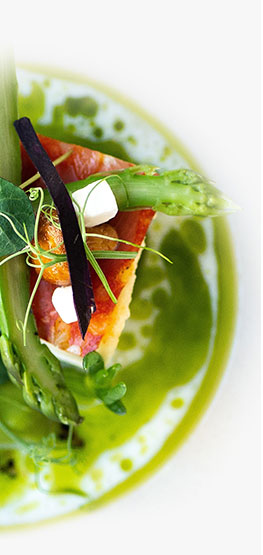
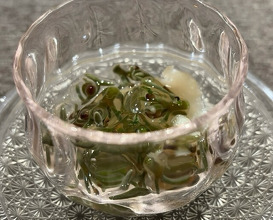
On Friday evening, I finished work on time and headed straight to Morioka Station. I took the Tohoku Shinkansen Hayabusa to Sendai Station, where I transferred to the local Yamabiko train and got off at my destination, Koriyama Station. From the west exit of the station, I took my usual shortcut, arriving in about 10 minutes. The journey from Morioka to Sendai took 39 minutes, and from Sendai to Koriyama, it took 46 minutes. I successfully arrived at one of Tohoku's top kaiseki restaurants, Marushin, where Chef Makoto Kumakura and Chef Hideyuki Suzuki showcase their culinary skills.Inside the restaurant, there were over twenty guests seated at three banquet tables, along with two pairs of customers at the counter. I was fortunate to be seated at the prime spot directly in front of Chef Kumakura, and I started by refreshing my dry throat with a draft beer, Master's Dream. After a brief pause, the "Kumakura Theater" for the month of June began.The first dish was served in a cool crystal bowl, featuring refreshing "Junsai" (water shield) and "Tsubugai" (whelk), setting the tone for the meal. This was followed by a luxurious dish of "Fugu" (pufferfish) with grilled "Shirako" (soft roe) and "Baigai" (Japanese clam), topped generously with shaved "Summer Truffle" right in front of me. Since it's June, this was likely the last chance to enjoy the soft roe of the fugu. The delightful aroma surpassed that of autumn's black truffle, enveloping the tender and fragrant fugu shirako. The crunchy texture of the baigai provided a perfect accent. The sequence of serving tsubugai followed by baigai was a signature move of Chef Kumakura, showcasing his adventurous spirit.Next, I enjoyed a cold corn soup made with "Usui Mame Endo" (green peas) puree, accompanied by grilled "Milky Sugar" corn, sweet, sour, salty, bitter, and umami flavors harmoniously combined with "Awamochi" (millet dumpling) and "Tonburi" (a type of seed often referred to as mountain caviar) in a citrus ponzu sauce. The chef's skill was evident in the soup, which featured "Hamo" (pike eel) from Ehime Prefecture, beautifully presented in a clear broth made from the eel's poaching liquid enhanced with kombu. The dish was rich and comforting, with the exquisite "Botan Hamo" (botan pike eel) held together with plum paste, garnished with a snake melon and a touch of green yuzu.The pike eel, which feeds on shrimp, crab, and octopus from the Seto Inland Sea, is said to develop a rich fat content in early summer and autumn. The eel, cut and prepared after being live-caught, had a refined umami flavor. The sashimi course featured thinly sliced "Suji-Ara" (a high-end fish known to connoisseurs), enjoyed with homemade salt ponzu. The pleasantly fibrous flesh released sweetness and umami in my mouth. The gelatinous skin was soft, and when wrapped around the flesh, it created a delightful experience reminiscent of fugu.The latter part of the sashimi course included "Aori Ika" (bigfin reef squid) with hidden cuts that clung to the tongue, along with "Hon Maguro" (bluefin tuna) tail, "Muro Aji" (mackerel), and "Hon Ara" (red sea bream), all of which were a feast for the palate. The highlight of the course was the seasonal vegetable platter, featuring "Amadai" (sweetfish) with crispy scales, perfectly grilled to contrast the moist texture of the flesh. Other dishes included tamagoyaki (Japanese omelet), Matsukaze (a type of fish cake), and kinpira gobo (stir-fried burdock root). For a palate cleanser, I enjoyed "Akahoya" (red sea cucumber) from Hokkaido, known as the "pineapple of the sea," paired with ripe pineapple. The simmered dish featured "Abalone," "Shark Fin," and "Kinmedai" (golden eye snapper) in a silver sauce, which was utterly divine. I also savored the fragrant grilled "Unagi" (eel) served over rice.For the main dish, I indulged in the fillet of "Uneme Beef," a brand of black-haired wagyu from Koriyama, grilled with ayame turnips, leaving me utterly enchanted. To finish, I enjoyed freshly made ju-wari soba (100% buckwheat noodles) served cold, along with a rice dish cooked with "Jako" (young sardines), a red miso soup with natural slippery mushrooms, and homemade pickles. For dessert, I had ice cream reminiscent of adzuki beans, walnuts, and sansho pepper, paired with the rich "Kijoushu Niida no Gosan" from Niida Brewery, marking the conclusion of the "Kumakura Theater" for June.The Japanese sake enjoyed throughout the meal included "Ippokki" Junmai Ginjo Natsukasumi, "Ubudachi" 2025 Yamada Nishiki, "Juyondai" Hiden Tamagaeshi Honmaru, "Hirotogawa" Tokubetsu Junmai, "Ginyak" from Yazawa Brewery, "Hiroki" limited sake from Fukushima, and "Tenro no Chuu" from Yazawa Brewery, a selection that any sake enthusiast would drool over.
We use cookies on this site to enhance your user experience.