We use cookies on this site to enhance your user experience.

Dinner at Madonnina del Pescatore
at
Madonnina del Pescatore
on 24 August 2026
- Photo Views
- 1
- Meal Views
- 57
Madonnina del Pescatore — Moreno Cedroni
Moreno Cedroni opened Madonnina del Pescatore in 1984, at only twenty, on this slightly unlikely stretch of Adriatic coast just south of Senigallia. What began as a relatively conventional fish restaurant gradually became one of the laboratories of modern Italian cooking. Cedroni received his first Michelin star in 1996 and his second ten years later, but perhaps the more consequential moment came through his exposure to Ferran Adrià and El Bulli. A stage there introduced him to a completely different way of thinking about technique, transformation and the possibilities of ingredients. You can still see that intellectual lineage in his cooking today, although over the decades Cedroni has developed a language unmistakably his own.
The 2026 “Luca and Moreno – The Evolution of Fish Bones, a Journey into the Fish Soul” menu is a particularly good example. Its central idea sounds almost academic: rather than treating bones, heads and other normally secondary parts of fish as waste, Cedroni and longtime collaborator Luca Abbadir turn them into ingredients in their own right through ageing, drying, smoking, extraction and fermentation.
The evening appropriately began with a Tribute to Ferran Adrià: the 1997 Parmesan “Gelato”, served with the 2016 Verdicchio Gran Riserva Extra Brut from Garofoli. More than nostalgia, it felt like an acknowledgement of where an important part of Cedroni’s culinary thinking began.
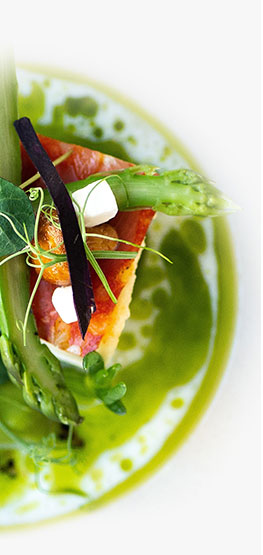
From there, the menu became progressively more ambitious: amberjack with rhubarb, spiny courgette, oxalis and a wafer made from the spines; a marine reinterpretation of pâté en croûte, incorporating monkfish head and tripe, sea-bream sausage, cuttlefish eggs and yuzu; turbot spines aged for two months with burnt herbs, yeast miso and acidulated corn; and Patagonian toothfish coated with its own spines after three months of ageing.
The maccheroncini “fumé” with tuna belly, sea buckthorn, smoked turbot spines and pecorino showed particularly well how the concept works when technique becomes flavour rather than an intellectual exercise. The tuna “ossobuco” continued the playful reinterpretation of familiar Italian forms, while the combination of one-month beeswax-cured lamb with tuna belly pushed the menu onto land without abandoning its central marine narrative.
What impressed us most was how extraordinarily well executed everything was. This is highly technical food, but it never felt as though innovation was being pursued simply to demonstrate technique. The menu was genuinely original and, unusually for cooking operating at this level of experimentation, remarkably coherent.
Service was equally outstanding. Our waiter had been trained by Tina Kragh of Jordnær in Copenhagen, and that pedigree showed: polished and precise, but relaxed enough to allow the evening to become a conversation rather than a performance.
That became particularly enjoyable with Cedroni himself. His El Bulli connection gave us plenty to talk about; having eaten at El Bulli fifteen times, I could trade a few war stories with him about Ferran Adrià and that extraordinary period in European gastronomy. It also made the opening tribute feel considerably more personal.
Cedroni then made a wonderful joke that probably explains the evolution of Madonnina better than any lengthy discussion of culinary philosophy. When he first opened the restaurant, he would come to the table carrying a basket full of whole fish, proudly showing his customers the day’s catch. More than forty years later, he said, he still comes to the table with fish — only now it arrives on a tray, with each piece treated individually and creatively: aged, fermented, dried, smoked or otherwise transformed.
In a way, that single image tells the whole story of Madonnina del Pescatore. The fundamental ingredient has hardly changed; what has changed completely is the thinking around it. The basket of whole fish has become a tray of carefully transformed pieces, yet Cedroni’s fascination with the fish itself has never disappeared.
More than forty years after opening Madonnina, he is still experimenting. There is plenty of history here, but surprisingly little nostalgia. The Fish Bone menu feels contemporary, curious and genuinely innovative — an extraordinarily well-executed dinner from a chef who, even after four decades, clearly hasn’t lost his desire to discover something new.
9 / 10

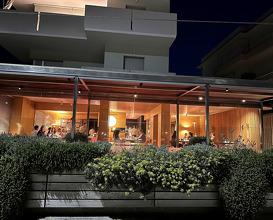
Restaurant exterior

Dining room and dinner

Tribute to Ferran Adria - Parmesan Gelato

Tribute to Ferran Adria - Parmesan Gelato

Verdicchio Gran Riserva Extra Brut - Garofoli 2016

Best breadsticks ever! Covered with furikake (ふりかけ)

Cracker with roses and oyster, rosolio and lychee cocktail

Amberjack cube, rhubarb sauce, spiny courgette, oxalis and spines wafer

Pate en croute, monkfish head and tripe, sea bream sausage, cuttlefish eggs and yuzu jelly

Burnt herbs, aged turbot spines, yeast miso and acidulated corn

Patagonian toothfish, aged-spine coating, pumpkin sauce and sweet-and-sour cucumber

Maccheroncini fume, tuna belly, sea buckthorn, smoked turbot spines and pecorino

Tuna ossobuco, green sauce, pickled cauliflower, mascarpone and apple mustard

Lamb cured in beeswax, tuna belly, cacciatora and fricassea, celeriac with lamb jus

Aromatic herbal tea, Judas' ear mushroom and grated smoked pumpkin

Spiced meringue sand, creamed dates with Tulakalum chocolate, goat's milk ice cream, gin and tonic sorbet, haworthia