We use cookies on this site to enhance your user experience.

Dinner at Antica Osteria del Mirasole
at
Antica Osteria del Mirasole
on 21 August 2026
- Photo Views
- 0
- Meal Views
- 67
Antica Osteria del Mirasole is one of Italy’s benchmark traditional trattorias—not because it modernizes Emilian cooking, but because it takes ostensibly simple, old-fashioned food exceptionally seriously.
Background & philosophy
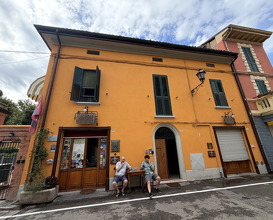
Franco Cimini founded Mirasole in 1989, aged just 22, deliberately recreating the atmosphere of an older local osteria that had existed around the Second World War. Over the decades he filled the rooms with old paintings, utensils and objects, while the large stone fireplace became both the visual and culinary heart of the restaurant. His wife Anna Caretti subsequently became central to the operation, particularly through the family agricultural business and dairy that supply ingredients to the restaurant.
Cimini’s philosophy is unusually uncompromising: great ingredients should taste recognizably of themselves rather than being transformed through elaborate technique. The result is food that looks rustic but is actually highly controlled. Offal, old cows, poultry, lard, cream, butter and live-fire cooking aren’t nostalgic props—they form the vocabulary of the restaurant.
This has made Mirasole a gastronomic destination in its own right. Gambero Rosso awards it Tre Gamberi, its highest trattoria distinction, while 50 Top Italy named it Italy’s No. 1 trattoria in 2020; it has subsequently remained around the very top of the national rankings. Cimini himself has repeatedly been recognized as one of Italy’s leading osti.
The food
The signature dish is almost certainly the tortellini alla panna d’affioramento Mirasole. This is precisely the sort of dish that explains Cimini. In Bologna, serving tortellini with cream rather than broth can be almost provocative. But Mirasole uses panna d’affioramento, the exceptionally rich cream naturally separated during the production of Parmigiano Reggiano. The dairy connection is particularly important: the menu explicitly describes the pasta section as an homage to Caseificio Sant’Angelo, “our dairy.”
Another defining dish is tagliatelle all’antico ragù di cortile, made using chicken giblets. It reflects the traditional farmyard principle of using the whole animal rather than treating offal as something exotic. La Cucina Italiana describes this ragù as one of Mirasole’s legendary dishes.
Then comes the fire. Old-cow neck and ribs, pork, lamb, veal, sausage, marrow and liver are cooked over wood embers. The fireplace is sufficiently fundamental that the Accademia Italiana della Cucina calls the fire at the centre of the dining room the restaurant’s “gastronomic soul.”
The current menu is wonderfully unfashionable: rabbit-liver-stuffed onion, chicken-liver crostini, snails, calf marrow, brains with fried zucchini, sautéed veal kidney, sheep leg on the spit and pork liver wrapped in caul fat sit alongside mortadella, culatello, tortellini and Bolognese cotoletta.
Dining experience
The surroundings reinforce the cooking. Rather than a polished Michelin-style dining room, Mirasole presents itself as an idealized old Emilian osteria: timber, accumulated objects, warm lighting and the smell and sight of the wood fire.
That informality shouldn’t be mistaken for casual cooking. Reviews repeatedly emphasize the quality of the raw materials, generosity, warmth of service and extraordinary precision underneath apparently simple dishes. Current customer feedback is similarly strong: roughly 4.5/5 from more than 1,000 reviews, with recurring praise for the ingredients, atmosphere and friendly service.
Assessment
What makes Mirasole particularly interesting is that it represents almost the opposite trajectory from contemporary fine dining.
There is little interest in tweezered presentation, novelty for its own sake or lengthy explanations. Instead, Cimini asks whether tortellini, cream, chicken giblets, mortadella, old beef or a piece of pork cooked over wood can be made so good that no reinvention is necessary.
That makes it more than a traditional Bolognese restaurant. It is essentially an argument for the continuing relevance of the osteria itself.
For your dinner, the dishes you actually ate are the one element I cannot responsibly reconstruct from the restaurant’s menu alone. If you send the photos/menu from 21 August, I can add the second part of the project brief: a dish-by-dish review of your actual meal, including presentation, texture, ingredients, technique and an overall assessment.
8 / 10


Course 01

Course 02

Course 03

Course 04

Course 05

Course 06

Course 07

Course 08


Course 09