We use cookies on this site to enhance your user experience.

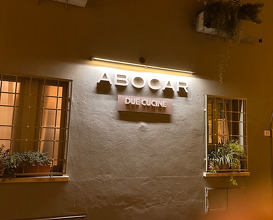
Abocar Due Cucine is one of Rimini’s most individual restaurants, built around the partnership of Argentine chef Mariano Guardianelli and Riminese Camilla Corbelli. They opened Abocar in 2013, after careers that had taken them through some serious European kitchens. Guardianelli worked at places including El Celler de Can Roca and Piazza Duomo, while Corbelli—herself trained as a cook—worked with Mauro Uliassi before ultimately making the dining room and hospitality her domain.
There is also a strong family connection to Rimini. Corbelli grew up around Il Lurido, her family’s famous local seafood restaurant. Abocar therefore isn’t simply an Argentine chef transplanting his cuisine to Italy: it grew from the meeting of Guardianelli’s Argentine background with Corbelli’s deeply Romagnolo restaurant heritage.
Even the name explains the philosophy. Abocar means roughly “to bring closer”, and Guardianelli and Corbelli use it to describe bringing together two geographically distant but culturally surprisingly compatible worlds. Rather than straightforward Italian-Argentine fusion, the cooking has gradually become its own language, using predominantly local ingredients while drawing freely on South American flavours, memories and techniques.
The restaurant received its first Michelin star in the 2019 Guide, five years after opening, and has retained it since. Interestingly, Guardianelli says Michelin was not initially their objective; the restaurant was conceived primarily around hospitality and making people comfortable rather than the formality sometimes associated with fine dining.
Our dinner illustrated this particularly well because Tomoko and I chose the two parallel €80 menus: Tomoko took the Fish Menu and I the Meat Menu.
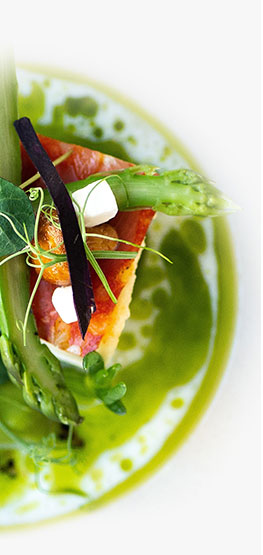
Both began with the same three snacks: tapioca and soyotta; maté with goat cheese and grapefruit; and a herb basket with herb pesto. Already, maté immediately establishes the Argentine connection, but without turning the meal into an exercise in national symbolism.
Tomoko’s fish progression was particularly unconventional. Mussel salad with black olive and ají panca combined the Adriatic with one of South America’s characteristic chillies. This was followed by fusillo, onion and lemon, and then, surprisingly, roasted eggplant with plums and herb pesto. The “fish” menu therefore wasn’t simply a succession of seafood courses: vegetables, acidity, herbs and fruit played equally important roles.
My meat menu moved in a different direction. Tomato with coconut and pink pepper was followed by chicory tortelli in pepper broth, before the principal meat course of lamb with borlotti beans and tarragon. It was a concise progression, and rather than relying on luxury ingredients or elaborate constructions, the interest came from unusual combinations and the tension between familiar Italian products and less expected aromatic references.
The two menus then converged again for dessert: apricot, fennel and capers, followed by “Oppure”, and finally fig, almond and rosemary.
This structure says a great deal about Abocar. Despite the restaurant’s name, the “two cuisines” no longer feel like two cuisines being deliberately fused. After more than a decade, Guardianelli and Corbelli have developed something more natural: a personal cuisine rooted in Romagna but informed by Argentina and by their years of travelling and cooking abroad.
What distinguishes Abocar is precisely this lack of rigidity. The meal can move from maté to mussels, ají panca to fusillo, chicory tortelli to lamb and borlotti without seeming interested in proving how clever the combinations are. It feels relaxed, curious and personal—an excellent expression of the restaurant’s original idea of avvicinare: bringing ingredients, cultures and people closer together.
8 / 10


Bread service

Welcome snacks

Bread accompaniment

Herbs basket and herbs pesto

Mate goat cheese and grapefruit

Tomato coconut and pink pepper

Chicory tortelli and pepper broth

Fusillo onion and lemon

Roast eggplant plums and herbs pesto

Lamb borlotti and tarragon

Mussels salad black olive and aji panca

Savoury course

Apricot fennel and capers

Fig almond and rosemary

Petit four