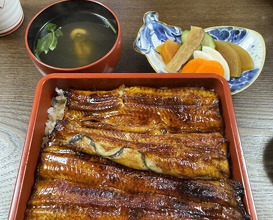
I visited the highly acclaimed restaurant, Unagi Tei Tomoe!Everyone kept raving about how delicious it is, so I had to check it out!I called around 10:30 AM to reserve some eel. It took a while to get through, but after 30 minutes of anticipation, I finally secured a reservation!It took about an hour to drive from central Tokyo.Once I arrived at the restaurant, I waited for 45 minutes. Surprisingly, I didn’t have to wait long even on a Saturday!Here’s what I ordered:- Natural yam dish (delicious!)- Water eggplant dish- Liver (with wasabi soy sauce) (delicious!)- Liver (with sauce)- Unaju (grilled eel over rice) (incredibly delicious!)And more!I usually prefer the Kansai-style grilling, so I didn’t have high expectations, but it was unbelievably good!If it’s this delicious, I wish I had come sooner!I definitely want to come back soon!### Grilling Methods of EelIn Japan, there are two main styles of grilled eel: "Kanto-style" and "Kansai-style." While okonomiyaki has a "Hiroshima-style," grilled eel is primarily categorized into these two methods. The main differences between these two styles are as follows:In Kanto, eels are opened from the back, while in Kansai, they are opened from the belly. There are various theories about this, but it is said that when grilled eel became popular in Kanto (Edo), the samurai society associated opening from the belly with "seppuku" (ritual suicide), which was considered unlucky, leading to the back-opening method.Conversely, in Kansai, the merchant culture thrived, and "opening the belly" was seen as a good thing, leading to the belly-opening method becoming the norm.In Kanto, the eel's head is removed, while in Kansai, it is left intact during cooking. This is simply due to the way the eel is prepared; when opening from the back, the head can get in the way, making it more efficient to remove it. In contrast, when opening from the belly, the head does not obstruct the process, so it is left on.It’s amusing to think about how the Edo people might have questioned why it was acceptable to remove the head for back-opening but not for belly-opening, reflecting the cultural sentiments of the time.Additionally, in Kanto, the eel's head is generally not eaten, while in Kansai, it has traditionally been called "Hansuke" and is often grilled or used to make broth.The definitive difference in grilling methods between Kanto and Kansai is that in Kanto, the eel is first grilled (or par-cooked), then steamed, and finally grilled again with sauce. In Kansai, there is no steaming process; the eel is grilled from start to finish.This difference is often attributed to the fact that Kanto people are generally more impatient, so to improve efficiency, they grill and steam the eel beforehand, then apply the sauce and grill it again when an order comes in. In contrast, in Kansai, merchants would take their time discussing business over meals, making the longer grilling method more common.There’s a saying in the eel chef community: "3 years for skewering, 8 years for splitting, a lifetime for grilling," which might suggest that the saying originated in Kansai since it does not mention steaming.Kanto-style grilled eel is known for its "torofuwa" (melt-in-your-mouth texture), while Kansai-style is characterized by a "karifuwa" (crispy yet tender) texture, which is a result of the different grilling methods.Interestingly, the eel restaurant "Yunagi" located in Hiroshima Prefecture, which is closer to Kansai, serves Kanto-style "torofuwa" grilled eel. Enjoy the fluffy, melt-in-your-mouth texture in your mouth!### Types of SkewersIn Kanto, bamboo skewers are used, while in Kansai, metal skewers are preferred. This is related to the aforementioned grilling methods; in Kanto, where steaming is involved, bamboo skewers are less likely to burn. It is said that using bamboo skewers serves as a guideline, as burning the skewer indicates overcooking or excessive heat.Conversely, in Kansai, where the eel is grilled without steaming, metal skewers are used since they do not burn even after long grilling times.### SauceKanto-style sauce is typically lighter and less sweet, complementing the eel's natural flavors due to the steaming process that reduces fat. In contrast, Kansai-style sauce is richer and sweeter, designed to stand up to the eel's fat. If Kansai is considered sweet, Kanto can be described as savory (strong in saltiness and soy sauce).Recently, it has become more common to enjoy grilled eel with salt or wasabi soy sauce, but when it comes to eel, grilled eel is still the classic choice. I highly recommend enjoying the fragrant grilled eel with the restaurant's unique sauce over a bowl of white rice!
We use cookies on this site to enhance your user experience.