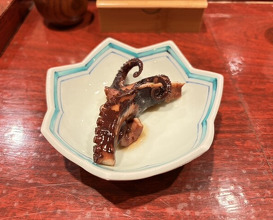
【Today's Order】Special Course with Beef and Eel - JPY 13,000+ Chilled SakeWhen it comes to eel in Hamamatsu, there are many renowned traditional restaurants, but Rin stands out as a place that cannot be defined solely as an "eel restaurant."The special course I enjoyed combined eel and beef. However, what I experienced was not a competition between the two, but rather a narrative that layered cooking techniques, dashi, aroma, temperature, and texture with each dish, culminating in a final eel rice bowl.The first dish, simmered octopus, was perfectly cooked yet had a delightful "crisp" bite. The gentle dashi, soy sauce, and sweetness of mirin made it a perfect pairing with the chilled sake, showcasing its high quality.Next was a bamboo rice dumpling topped with grilled eel and a flavorful sauce. The sauce, enriched with dashi, took center stage. The chewy, half-cooked glutinous rice absorbed the dashi, releasing the rich fat and flavor of the eel from the center. The contrast between the light dashi on the outside and the rich eel inside was remarkable.The beef dishes consisted of three types of skewers and hanging tender. The beef tongue, made from the very center of the tongue, was grilled over charcoal to a perfect rare. It was one of the best beef tongues I’ve ever had, achieving a melt-in-your-mouth tenderness while maintaining the characteristic chewiness of tongue.The liver was rich and sticky with umami, yet surprisingly free of any off-flavors, enhanced only by sesame oil and salt.The hanging tender offered a robust red meat flavor, with a firm texture and sweet fat that paired beautifully with freshly grated wasabi.The served fruit tomato with dashi was exceptional. It had no grassy taste, and the umami from glutamic acid, dashi, and gentle sweetness and acidity washed away the lingering flavors of the beef, leaving a clean palate ready for the next dish.The highlight of this course was the grilled dewa eel. The skin was scored with fine cuts, allowing excess fat and gelatin to escape while being grilled over charcoal, imparting a fragrant aroma to the flesh. The surface was crispy, and the inside was cooked just right, not overdone. It was not only tender but also had a rich, sticky umami and sweetness that was impressive. I was moved by how much the technique of grilling and the quality of the ingredients were expressed with just salt and fresh wasabi.The eel salad was also wonderful. The smooth texture of the Niigata-produced hanamozuku, the fresh aroma of cucumber, and the gentle acidity made the grilled eel surprisingly light and easy to eat. It beautifully distinguished the charm of the sauce from the grilled eel.The final beef dish was grilled hanging tender, served with a recommendation to wrap it in Korean perilla leaves with your hands instead of chopsticks. The experience of feeling the meat's warmth in your hands as you wrap it and bring it to your mouth became part of the dish itself. The refreshing texture of the perilla leaves and the fragrant aroma of sansho pepper beautifully complemented the rich sauce and robust flavor of the hanging tender.The concluding eel rice bowl was the resolution of this course.What surprised me was not the eel itself, but the rice. The sun-dried rice from Uonuma was cooked in a traditional pot, and by not damaging the surface of the grains, the sweet aroma of freshly cooked rice was intentionally subdued, allowing the natural sweetness to burst forth only when bitten. The combination of the sauce, eel fat, sweetness of the flesh, and the aroma of the skin created a sensation of "the rice itself melting away"—a first for me.The liver soup was also memorable. The richness of the liver was intense, yet instead of using mitsuba, it was paired with garlic chives. By skillfully utilizing the aroma of the chives, the individuality of the liver was preserved while balancing the aftertaste without adding texture or weight. This bowl reflected the chef's design philosophy.What impressed me most about this course was not just the dishes themselves, but the overall composition.The beef showcased the individuality of each cut, while the eel displayed the uniqueness of each cooking method. Dashi, charcoal grilling, acidity, aroma, and temperature all had meaning in each dish, arranged to welcome the next course in the best possible state.Rin is neither an "eel restaurant" nor a "grilled meat restaurant."It is a place that designs ingredients, fire, dashi, aroma, and temperature as a single flow and reconstructs them as Japanese cuisine.It was a truly unique experience in Hamamatsu. I definitely want to visit again.
We use cookies on this site to enhance your user experience.