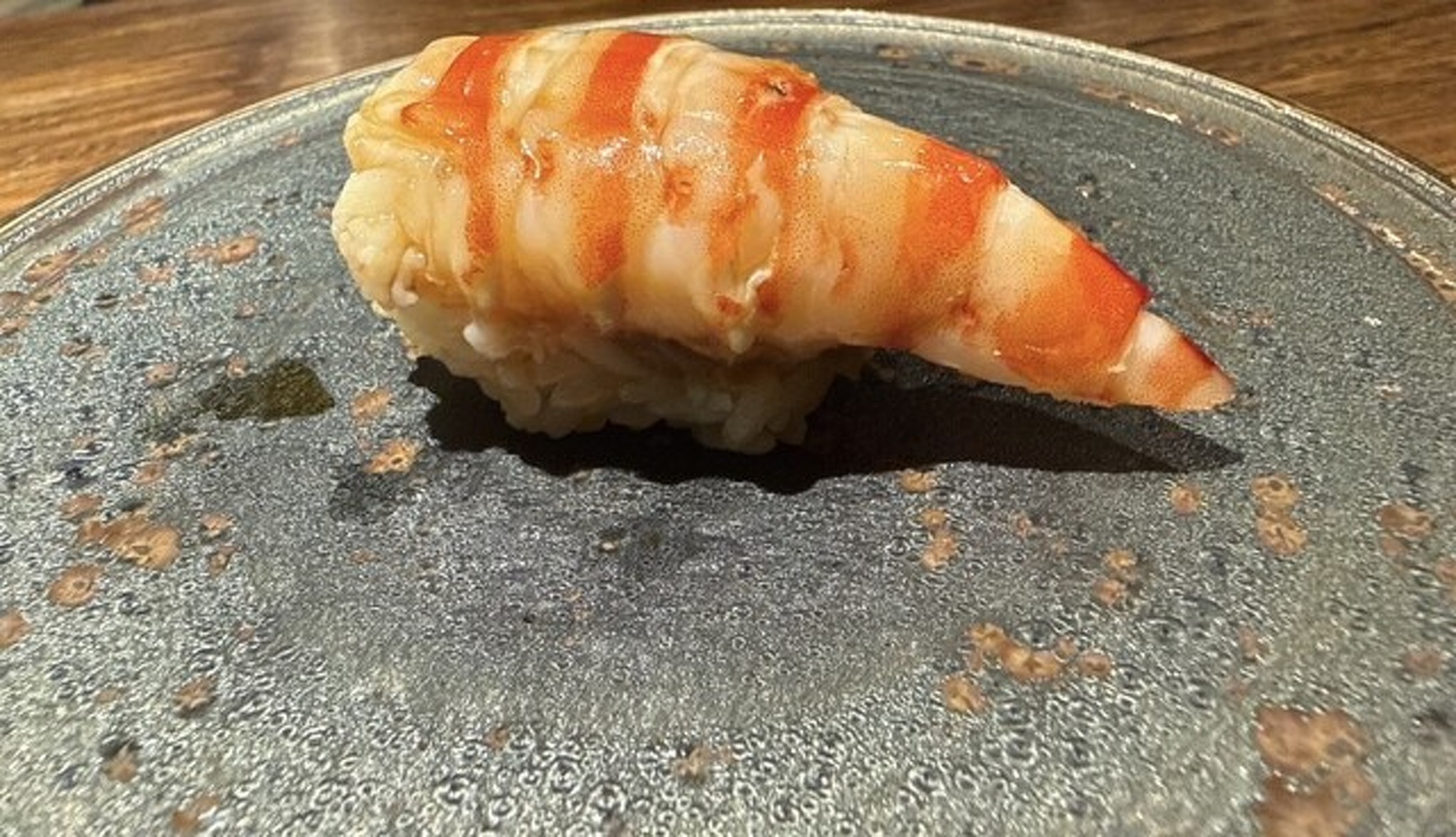
I sometimes hear people say, "Isn't Hiroshima just about okonomiyaki?" As someone who teaches history and loves Hiroshima's cuisine, I have long prepared a rebuttal to this claim. Today, I want to start that rebuttal with a piece of shrimp I had at Soshi in Tachimach.Soshi is a reservation-only sushi restaurant located just a short walk from the Tachimach tram stop. They serve only omakase. It is one of the most difficult restaurants to book in Hiroshima and has won awards from Tabelog. Once seated at the counter, a variety of Setouchi fish is served one after another.The most memorable dish of the day was the grilled shrimp nigiri.The freshly boiled shrimp had distinct red and white stripes, and the flesh was still plump. When I took a bite, the firm texture revealed a gentle sweetness of the shrimp. People often only remember how sweet shrimp can be when they visit a high-end sushi restaurant.Another standout was the sea urchin gunkan made with red uni from Suo-Oshima. Red uni is a summer treasure of Setouchi, harvested in limited quantities and rarely found in markets. It was rich and had a clean aftertaste, completely free from the usual ammonium smell. I believe this is a piece that those who only know Hokkaido uni should definitely try.Now, let’s take a detour into my professional habit: discussing the claim that "Hiroshima is not delicious."First, it’s important to note that nigiri sushi was invented in Edo (Tokyo). It originated as fast food in the early 19th century, and one of the reasons it spread nationwide was the Great Kanto Earthquake of 1923. Sushi chefs who lost their jobs in Edo scattered to their hometowns and regional cities, transplanting the "Edo-mae" techniques across Japan. This means that regional sushi is, to some extent, competing on the basis of the "Edo format."However, the Setouchi Sea is shaped by a different philosophy.Unlike the fatty fish from the Pacific, such as tuna, or the winter yellowtail from the Japan Sea, there aren’t many fish that hit you with fat. Instead, you find small sardines, rockfish, mackerel, eel, and various white fish. In Hiroshima, there’s a saying that "if you wash small sardines seven times, they taste like sea bream," reflecting a culture that carefully handles small, delicate fish. As for oysters, they have been sold to Osaka on "oyster boats" since the Edo period, making them a 400-year tradition.In short, the flavors of Setouchi are about "subtractive taste." It’s not about the violence of fat but rather competing with the resolution of subtle umami.Many who say "Hiroshima is not delicious" probably don’t realize this difference in resolution. If you measure deliciousness by obvious fat and richness, the white fish from Setouchi may seem "tasteless." But that’s akin to looking at a sumi-e painting and saying, "It has no color."There’s also a local aspect to consider. This city tends to consume its best offerings locally. Small sardines and red uni are highly perishable and difficult to distribute, so they rarely appear in Tokyo restaurants. This means that the best parts of Hiroshima’s cuisine can only be enjoyed by visiting Hiroshima. It’s not that the branding is poor; it’s simply that they cannot be exported.The shrimp and red uni I had at Soshi were, I believe, at the forefront of this "non-exportable Hiroshima."I want to take that acquaintance who says, "Hiroshima is not delicious" here someday. I want them to silently enjoy the red uni gunkan without any explanation. Sometimes, a piece of sushi can be a stronger rebuttal than words.
We use cookies on this site to enhance your user experience.