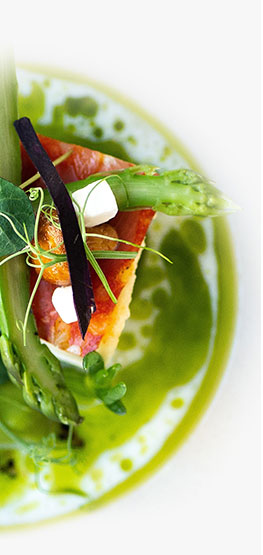
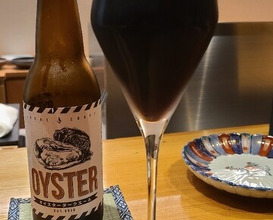
Located just a 2-minute walk from the Hiroshima Electric Railway Ginzan-cho Station, Tori Yamamoto opened in 2024, run by Chef Yamamoto and his wife. Situated on the second floor of a building behind the Momiji Bank headquarters, the exterior features a black-painted wall with a wooden sliding door and a white noren curtain hanging down. Inside, the restaurant has a serene atmosphere with pale green earthen walls and a grill station at the center, complemented by counter seating that faces each other, creating a refined space. There are a total of 11 seats, including 6 at the counter and 5 in private rooms. The chicken served here is sourced from "Kashiwa no Kawanaka" in Otsu City, Shiga Prefecture, featuring three types of local chicken: Nagoya Cochin, Omi Jidori, and Awami Jidori, along with the Higashi-Hiroshima Koi Jidori, the first commercially produced local chicken in Hiroshima, born in 2019. On this occasion, I invited a friend for a dinner gathering, and we enjoyed the Nagoya Cochin Special. Thank you very much. m(_ _)m However, being the second stop of the night was a bit of a disadvantage. Chef Yamamoto seems to have a deep understanding of each part of the chicken, and I felt a strong commitment to providing delicious dishes. The chicken is brushed with chicken fat, seasoned with salt, and finished with a sprinkle of seaweed salt before serving. The pairing of yakitori and drinks is excellent; the sake is chosen by the chef, while the wine is selected by his wife. While beer is the classic pairing with yakitori, experimenting with different drinks can lead to surprisingly satisfying combinations. I believe that by limiting the number of seats and focusing on yakitori and the customers, a positive cycle has been created. Recently, the cooking has become more rare, highlighting the deliciousness of the local chicken. When I asked, "Is it cooked a bit rare?" the chef replied, "Yes, I prefer it that way personally, but many people in Hiroshima prefer their yakitori well-cooked." Since there are no local chicken farms in the prefecture and only broiler production sites, it seems that the idea of cheap, well-cooked yakitori has taken root among Hiroshima residents. I believe Chef Yamamoto is pioneering truly delicious yakitori in Hiroshima, and I hope he continues to strive for even greater heights. The Nagoya Cochin Special course (JPY 15,000, tax included) plus drinks totaled JPY 18,000. I feel that the chef is constantly experimenting with cooking methods, seeking the ultimate way to prepare the chicken. I have included explanations with the photos. It was a great meal. Dishes (All chicken is Nagoya Cochin Special):1. Chicken breast sashimi with sansho sprouts2. Kombu-marinated chicken breast sashimi with sudachi3. Gizzard sashimi with sesame oil, snow salt, and shiso flower4. Chicken breast tataki (salt) served cold with seaweed salt (from Kankari, Hiroshima) and mustard5. Inner thigh tataki (salt) served warm6. Micro vegetables (from Kuai, Hiroshima, Kajitani Farm)7. Grated daikon with ponzu8. Furisode (salt)9. Sole and inner thigh (salt)10. King oyster mushroom (salt)11. Neck meat (salt and mustard)12. Salted napa cabbage and salted cucumber13. Outer thigh (salt)14. Zucchini (salt)15. Chicken wings and drumsticks (salt)16. Charcoal-grilled raisin bread topped with liver pâté and 86% cacao17. Green asparagus (salt) (from Sera, Hiroshima)18. Chawanmushi with bonito dashi, Nagoya Cochin, and Parmigiano-Reggiano19. Back liver and white onion (sauce)20. Belly and garlic shoots (salt)21. Oyakodon (parent-child rice bowl)22. Homemade ice CatalanaThe basic explanation of the Nagoya Cochin Special used at Tori Yamamoto is as follows:△▼△▼△▼△▼△▼△▼△▼△▼△▼△▼△* Nagoya Cochin is a remarkable breed of local chicken created in the Meiji era by brothers Sohei and Masahide Kaifu, who were former samurai of the Owari domain. It is a hybrid breed developed by crossing local chickens with Buff Cochin (a Chinese breed). Known as the Nagoya breed, it was recognized as the first domestic utility breed by the Japan Poultry Association in 1905 (Meiji 38). Currently, only those raised from the mating of male and female Nagoya breeds are called Nagoya Cochin (purebred). Their lifespan is about 5 to 8 years, and they start laying eggs approximately 180 days after birth, which is considered their early youth. Particularly, the chickens raised by "Kashiwa no Kawanaka" are nurtured for about 180 to 200 days, which is more than double the usual time, ensuring they are well cared for. The Nagoya Cochin Special consists of female Nagoya Cochin raised by "Kashiwa no Kawanaka" (Otsu City, Shiga Prefecture), where only the best individuals are selected at the chick stage (first selection) and raised in a free-range environment. Only those that have grown in optimal conditions (second selection) are shipped as Nagoya Cochin Special. The number of these chickens is extremely limited.
We use cookies on this site to enhance your user experience.