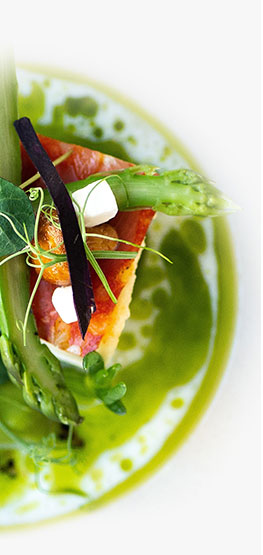
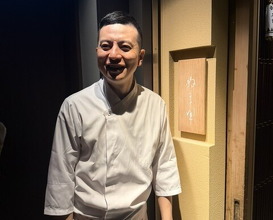
A two-day trip to Osaka. This week, I had six Shinkansen rides planned, and at first, I hesitated. However, I received an invitation from the organizer I always rely on, and it was for the platinum seat at the best tempura restaurant in Kansai. I thought I had to go, so I booked a hotel right next to the restaurant and headed over. After enjoying the large public bath and open-air bath, I had a little drink before coming here.Upon entering the restaurant, I was greeted by a beautiful wooden counter. I wondered if it was brought in by a crane. The lighting and counter blend together, creating a warm atmosphere.Once seated, an apprentice handed me a wooden box. I hold a kimono instructor certification, but I hesitated to untie the cord, thinking it was the same as at another restaurant (laughs).When I opened the wooden box, I found an original embroidered hand towel inside. It was adorable.Now, this place has two Michelin stars and a silver rating on Tabelog, showcasing its impressive skills. During this season, I've been trying a lot of tempura, and I was looking forward to the tempura from Chef Numata, who hails from Kumamoto.I am captivated by the charm of tempura, where the same ingredients can taste completely different depending on the chef's skill.Chef Numata's tempura is crispy and light. It brings out the best in the ingredients, allowing me to enjoy the texture. I mostly enjoyed it with just salt.Moreover, he truly maximizes the use of the ingredients. Grilled white asparagus was served as a puree. While many places serve a new onion puree at this time of year, I was surprised to see white asparagus used instead... all the fibers were removed. I was impressed right from the start.The white bamboo shoot is nearing the end of the season, but it seems I just made it in time. I thought it would be served at the beginning, but it was presented towards the end of the course. The sauce was fragrant and crispy, yet the juiciness was irresistible.The combination of sakura shrimp, mizuna, and kombu vinegar was wonderful.To finish off, the yam somen with bonito flakes and kombu dashi was excellent.For the rice dish, I chose tempura sushi. I had never had tempura sushi at a tempura restaurant in Tokyo. There were two types of tempura sushi.The course was structured in a way that kept it interesting until the end. I thoroughly enjoyed the tempura of Osaka.And thank you for the notes.Course: JPY 35,200 + service charge - White asparagus puree (from the Loire region), topped with sansho young leaves. Seasoned with salt, the fibers and skin were removed, showing great care in preparation.- Low-temperature fried and then charcoal-grilled Isaki (from Ehime Prefecture). The skin was fragrant, and the flesh was rare and translucent. I was curious about how it was cooked. Served with salt and wasabi.- Comparison of the heads of Kuruma shrimp (from Amakusa, Kumamoto Prefecture). When eaten as is, it was fragrant, and with salt, it tightened up but had a hint of sweetness.- Kuruma shrimp (from Kumamoto Prefecture, Amakusa).- Rare Kuruma shrimp (from Kumamoto Prefecture, Amakusa). When enjoyed with salt, the sweetness doubled.- Kawachi Issun Sora Mame (from Tomioka, Osaka Prefecture). It seems that only two beans grow in a single pod.- White fish (from Awaji Island, Hyogo Prefecture, aged for 3 days) with the skin folded in. In Tokyo, you would typically find the Megochi from Tokyo Bay, but in Kansai, they serve aged white fish. Since it is aged, the flavor of the fish, which can be bland, spreads in the mouth when fried.- Tara no Me (from Hyogo Prefecture). This seasonal delicacy was crispy and crunchy.- White fish bone crackers (from Awaji Island, Hyogo Prefecture). In Tokyo, you would find anago bone crackers, but perhaps in Kansai, it's white fish. It pairs well with Japanese sake.- Young sweetfish (from Lake Biwa, Shiga Prefecture). The young sweetfish had just been swimming energetically until a moment ago. It truly is from Lake Biwa.- Sakura shrimp (from Suruga Bay, Shizuoka Prefecture), with red shiso & red mustard mizuna & green mustard mizuna & Kujo green onion sprouts, sprayed with kombu vinegar. I love this combination. The structure of the course also provided excellent palate cleansers.- Aoyagi (from Hokkaido), served on a bed of nori. Instead of being handed to me, I had to wrap it in nori myself.- Rape blossom (from Hyogo Prefecture). This seasonal delicacy was crispy and crunchy.- Kue (from Amakusa, Kumamoto Prefecture, belly, 22kg, aged for 1 day). I was surprised to see Kue served at this time of year. The rare Kue melted in my mouth with its umami. The cooking was superb.- Zucchini pistil (from Aichi Prefecture) & Kuruma shrimp (from Amakusa, Kumamoto Prefecture).- Yam somen, with tuna flakes & Rishiri kombu & true kombu dashi, topped with shiso flowers. I had heard rumors about this, but the texture was irresistible.- Fresh white bamboo shoot (from Kizumi, Osaka Prefecture).- White bamboo shoot (from Kizumi, Osaka Prefecture), served with a reduced tempura sauce and topped with sansho young leaves.- White rice (from Okayama Prefecture, Momotaro, using duck farming methods), with neba na.- Tachiuo (from Kozu, Kanagawa Prefecture).- Red miso soup with yellow chives.- Sweet potato (variety: Beni Haruka, from Akita Prefecture). Sweet and comforting, it was a dessert.- Tempura sushi (with pickled ginger & mitsuba & tempura sauce).- Pickles (turnip, asparagus stalks, cucumber).- Strawberries (variety: Koto Ka, from Nara Prefecture) & gelato, drizzled with elderflower syrup.**Drinks** - White wine (Koshu) - Ubuzuna Yamada Nishiki 2, unpasteurized sake - Morishima Miyama Nishiki Junmai Sake - Toyonokuni Junmai Ginjo Toyonokuni Rice - Firmin Dezat Pouilly Fumé 2024Total: JPY 44,000.
We use cookies on this site to enhance your user experience.