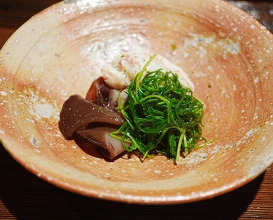
Nestled in a back alley of Ningyocho, the Japanese restaurant "Isoda" proudly displays its noren (curtain). The owner, Takuto Isoda, spent about two years at a Japanese restaurant in Osaka before honing his skills for eight years at "Shinbashi Hoshino," and then opened his own establishment in April 2021. Initially starting in a pre-existing space, he later relocated to its current location in Ningyocho. This move was not just a change of address; it was a transformation that infused the space with his personal touch, bringing it closer to his vision of "Isoda." The current restaurant, centered around a white wood counter, reflects a heightened aesthetic sensibility not only in the dishes but also in the overall ambiance.The course of the day flows with a rhythm that lightly showcases summer ingredients. The dishes are designed to absorb dashi, layer aromas, and vary textures. While rooted in traditional Japanese cuisine, each plate introduces subtle changes. As the meal progresses, a grand rice festival unfolds, culminating in a refined beginning and a complete takeover of appetite by the end. It’s a delightful experience that keeps you on your toes."Hairy crab, wood ear mushrooms, and okahijiki" present a harmonious blend of flavors. The soft sweetness of the crab combines with the crunchy texture of the mushrooms and the crispness of the okahijiki, creating a dish that outlines its flavors through texture rather than just taste. There’s a well-thought-out structure behind the refreshing appearance."Mackerel sushi, hōzuki (Chinese lantern plant), and okra" features the rich fat of the mackerel enhanced by ginger. The first bite reveals the umami of the fish, followed by a gentle hint of ginger. The sweet and sour notes of the hōzuki and the fresh aroma and stickiness of the okra create a delicate interplay of flavors on the small plate."Grilled soft-shelled turtle" showcases the power of charcoal grilling. The surface is perfectly charred while the inside retains the unique gelatinous texture and deep flavor of the turtle. The smoky aroma complements the rich taste, and the simplicity of the dish allows the quality of the ingredients and the grilling technique to shine."Meita flounder and white squid" create a refreshing visual contrast with white seafood on a blue plate. The meita flounder releases its umami with each bite, while the white squid’s delicate knife work enhances its sweetness. Within the same pale color scheme, the contrasting textures of crunchiness and stickiness emerge. A touch of wasabi sharpens the flavors even further."Deep-fried sweetfish, sansho pepper, and cucumber" is served whole from head to tail. The batter is crispy and fragrant, while the fish retains its characteristic bitterness. The sansho pepper elevates the aroma, and the cucumber’s juiciness balances the aftertaste. Despite the wildness of the river fish, the overall experience is surprisingly refreshing."Tempura of sweet corn" allows you to savor the season's sweetness directly. The thin batter encases the corn kernels, which pop with a delightful crunch, followed by a natural sweetness that lingers."Shrimp, winter melon, and water shield soup" features plump shrimp bouncing in a clear broth, while the water shield glides smoothly. However, it’s the winter melon that steals the show, soaking up the dashi and releasing its umami with each bite. Its unassuming appearance belies its eloquent execution, making it surprising that the winter melon outshines the shrimp."Grilled red snapper with crispy scales" is a dish that sounds as good as it tastes. The scales crackle lightly, revealing tender flesh underneath. The rich fat of the snapper is balanced by a vibrant green sauce that refreshes the palate. The combination of smokiness, richness, and freshness creates a strong initial impression, yet leaves a light finish."Kamo eggplant and small potatoes simmered together" showcases the technique of infusing dashi. The kamo eggplant melts into a creamy texture, while the small potatoes maintain a smooth mouthfeel. Both ingredients absorb the dashi without losing their individual characteristics. Just like the winter melon earlier, at "Isoda," vegetables do not play a supporting role; the moment they absorb the dashi, they become the stars of the dish."White miso with figs" provides a moment to catch your breath. The sweetness of the figs pairs beautifully with the creamy richness of the white miso. The soft textures overlap, slightly slowing the pace of the course. However, this is not a break.The real challenge begins here.First up is "Rice with young ginger and Manganji peppers." The refreshing spiciness of the young ginger and the green aroma of the Manganji peppers combine with the umami of the dashi, infusing each grain of rice with flavor. The refreshing aroma and the umami of the rice intertwine, making it hard to stop eating. It’s quite difficult to limit yourself to just one bowl.Next comes "Bonito flakes rice," "white rice," and "egg over rice," each changing the expression of the white rice as they stack up. The "white rice" is accompanied by simmered beef, chirimenjako (tiny dried sardines), and pickles. With all these elements enhancing the rice, counting the number of bowls becomes meaningless.Then, there’s "Soft-shelled turtle dashi over rice." Pouring the golden dashi over the rice enhances its sweetness with the richness of the turtle. The umami is deep yet leaves a clean aftertaste. Adding an egg transforms it into "soft-shelled turtle zosui (rice porridge)." Even though I should be full by now, I find myself savoring every last drop. It seems there’s still room in my stomach for more.For dessert, there’s "Andesu melon and Sato Nishiki cherries." The juicy sweetness of the Andesu melon and the refined acidity of the Sato Nishiki cherries provide a refreshing conclusion to the rice festival, cooling down my fully satisfied stomach.The cuisine at "Isoda" does not shout for attention. Yet, as you continue to eat, its presence grows stronger. The textures layered over the hairy crab, the bitterness of the sweetfish, the sound of the red snapper scales, and the dashi soaked into the winter melon all come together. With a solid foundation built on the skills honed during his training, it feels as though the contours of his restaurant name have become even more pronounced in this current location. It was a great meal.
We use cookies on this site to enhance your user experience.