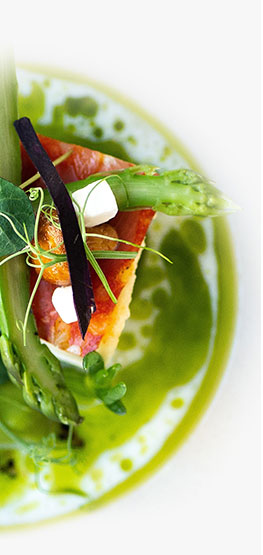
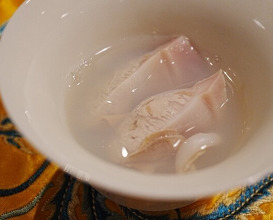
Located about a 10-minute walk from Hiroshima Station, the Chinese restaurant "MASUKI" stands quietly in a corner of Kyobashi-cho.Founded on February 23, 2015, the owner, Toshiyoshi Masuki, has honed his skills in Yokohama's Chinatown. He crafts dishes that transcend the boundaries of Cantonese and Beijing cuisine, creating a multi-course experience with seasonal ingredients. While the dishes are rich in the robust flavors and aromas characteristic of Chinese cuisine, they also embody a modern sensibility in terms of cooking techniques, textures, and presentation. Incorporating local ingredients such as seafood from Setouchi and chicken from Higashi-Hiroshima, the restaurant balances tradition with a contemporary impression, which has become its unique identity.The meal begins with "Natural Clam Soup." This dish features natural clams from Kamojima in Masuda City, Shimane Prefecture, floating in a clear broth. The clam meat is plump, and with each bite, a gentle brininess spreads across the palate. The simplicity of relying solely on the clams and broth to open the course is refreshing. It may start quietly, but it leaves a lasting impression.Next is "Braised Pork Shank Jelly." This dish uses the front legs of the Happy Pig from Fukudome Farm in Kanoya City, Kagoshima Prefecture. The modern aesthetic is immediately apparent in its elegant presentation. Upon tasting, the cold gelatinous texture melts on the tongue, gradually releasing the rich flavor of the pork. This classic dish is presented in a contemporary manner, including its visual appeal.Following that is "White Clam and Yellow Chives." The white clams from Yamaguchi Prefecture are impressively crunchy. The soft aroma of yellow chives complements the dish, while the richness of soy sauce ties everything together. The sweetness of the clams, the fragrance of the vegetables, and the depth of the fermented seasoning are all distinct, creating a three-dimensional aroma typical of Chinese cuisine within a simple structure.Next is "Bang Bang Chicken." The chicken from Higashi-Hiroshima is cooked to a moist perfection. The meat has a pleasant firmness, and the flavor intensifies with each bite. While the sesame aroma and richness are layered on, the natural taste of the chicken remains intact. The dish strikes a perfect balance between richness and refinement.The "Mackerel and Cucumber with Sesame Dressing" showcases the chef's skill in cooking. The surface is finished with a high-temperature sear, while the inside retains a delicate texture that melts in the mouth. This texture can only be achieved by accurately passing through the desired temperature range. The refreshing cucumber and the richness of sesame balance the fish's fat, enhancing the aftertaste. While it appears mild, the changes in temperature and texture are vivid in the mouth."Century Egg Tofu" combines the rich, sticky flavor of century egg with the smooth texture of tofu. The aroma of sesame oil provides definition, creating a dish that is dense yet not heavy. Given the familiarity of this combination, the chef's sense is evident in the balance of density and aroma."Saddleback Pork Char Siu" features thickness, tenderness, and aroma in perfect harmony. As you bite into it, the meat fibers break apart, and the sweetness of the fat spreads. The roasted aroma on the surface, the moistness in the center, and the lingering fat create a delightful three-stage transformation. Even in this classic dish, the restaurant's technique is clearly evident."Shark Fin and Water Shield" was particularly memorable in this course. Instead of a rich white broth, it is paired with a clear soup. The slippery texture of the water shield adds to the dish, while the aroma of green onion oil enhances the aftertaste. Enjoying the fibrous texture of the shark fin, the flavor remains clear until the end. This innovative approach does not rely solely on heaviness."Setouchi's Akou" features perfectly cooked white fish, layered with the spice of Japanese pepper and the fresh aroma of Manji chili. While centering on the elegant umami of the Akou, spices and vegetables create a contrast in flavor. This expression of Setouchi seafood through the lens of Chinese cuisine is a hallmark of this restaurant.The meal concludes with "Yuzu Ramen." Thin noodles swim in a clear broth, highlighted by the refreshing aroma of yuzu. Beneath it lies the umami of kombu, with a depth reminiscent of shiitake mushrooms, even though shiitake is not actually used, which is intriguing. The layering of multiple umami flavors evokes nuances that shouldn’t exist. The precision in making the broth directly contributes to the richness of the aftertaste. Despite being full, I couldn't put down my chopsticks.Finally, we have "Almond Tofu." Its smooth texture and almond aroma gently round off the meal's aftertaste. Amidst the flow of strong flavors and aromas, it lands softly at the end, beautifully summarizing the dining experience.While maintaining a solid foundation as Chinese cuisine, MASUKI infuses modern sensibilities into textures and presentations. Incorporating local ingredients from Setouchi and Higashi-Hiroshima, it flexibly adapts seasonal produce into its courses without solely relying on local ingredients. It neither merely traces tradition nor solely pursues modernity. The ability to harmoniously coexist both elements is the charm of "MASUKI." I look forward to experiencing its different expressions in the next season. It was a great meal.
We use cookies on this site to enhance your user experience.