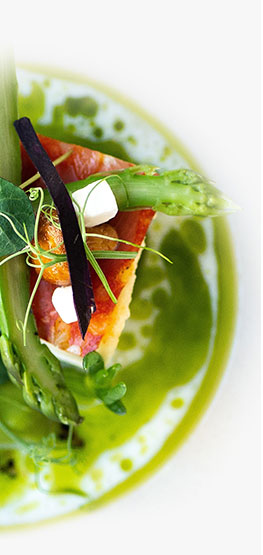
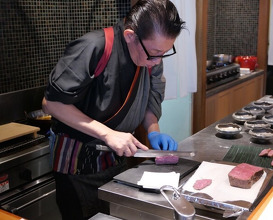
I was finally able to visit my favorite kaiseki restaurant, Chisousottakuito, for the first time in about six months. I had hoped to come during the season for junzai (water shield), but unfortunately, that didn’t work out, and I arrived a bit late.Nonetheless, I was able to fully enjoy the fresh seafood from the Seto Inland Sea this time.I visited during the lunch hour on a holiday, which is very convenient for a day trip.On this day, I had:- Fresh sea bream from Ohtake, Hiroshima, served with spicy Japanese radish- Red sea urchin and yam from Oshima, Yamaguchi, with a dashi jelly- Steamed abalone from Kure, Hiroshima- Soup with white sweet sea bream in Rishiri kombu dashi- Sashimi including: - Aged grouper (5 days) - Grouper belly - Grouper throat - Isaki (grunt) - Sliced longfin tuna (4 kg) - Served with mustard - Tachiuo (beltfish)- Rice porridge with grouper, white sweet sea bream, young sea bream, and mozuku seaweed- Charcoal-grilled Takamori Wagyu from the inner thigh, with a melting point of 17°C- Hamo (pike eel) soup in true kombu dashi- Fried Kyoto eggplant- Black sesame tofu- TeaIt was a wonderful experience to see how Chef Hirano skillfully handles such exquisite ingredients. The water, kombu, and katsuobushi used for the dashi are tailored for each dish. I learned that the soft water from Hiroshima is particularly suitable for making dashi.Once again, the combination of honkarebushi (smoked bonito) and aged kombu delivered an umami punch that was beyond my expectations. The richness of the dashi made with Hiroshima's soft water was surprisingly refreshing.While the seafood here is delicious, I secretly consider myself a fan of Takamori beef. Although the main focus of kaiseki is seafood, having too much of it can sometimes become monotonous. Fortunately, this restaurant often serves meat, which I greatly appreciate.From start to finish, I was thoroughly impressed. Thank you, Chef Hirano, Kimura-san, and all the staff!
We use cookies on this site to enhance your user experience.